Human Orbital Spaceflights

International Flight No. 33Soyuz 7BuranUSSR |
 |
Launch, orbit and landing data
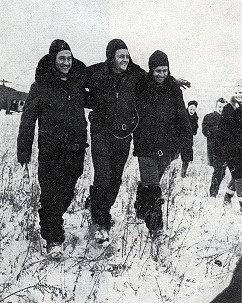
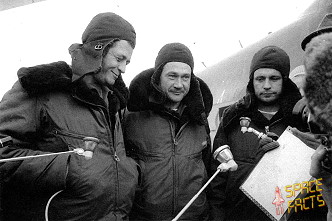
walkout photo |
 |
|||||||||||||||||||
alternative crew photo |
alternative crew photo |
|||||||||||||||||||
alternative crew photo |
alternative crew photo |
|||||||||||||||||||
alternative crew photo |
alternative crew photo |
|||||||||||||||||||
Crew
| No. | Surname | Given names | Position | Flight No. | Duration | Orbits | |
| 1 |  |
Filipchenko | Anatoli Vasiliyevich | Commander | 1 | 4d 22h 40m 23s | 80 |
| 2 | |
Volkov | Vladislav Nikolayevich | Flight Engineer | 1 | 4d 22h 40m 23s | 80 |
| 3 | |
Gorbatko | Viktor Vasiliyevich | Research Engineer | 1 | 4d 22h 40m 23s | 80 |
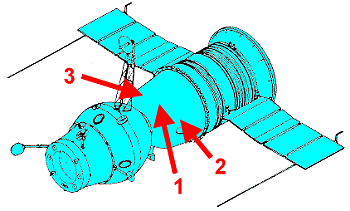
Crew seating arrangement
|
 |
|
||||||||||||||||
1st Backup Crew
| No. | Surname | Given names | Position | |
| 1 | |
Shatalov | Vladimir Aleksandrovich | Commander |
| 2 | |
Yeliseyev | Aleksei Stanislavovich | Flight Engineer |
| 3 | |
Kolodin | Pyotr Ivanovich | Research Engineer |
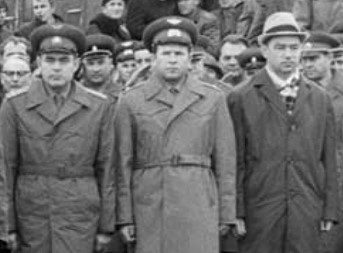
2nd Backup Crew
 |
 |
||||||||||||||||||||
Hardware
| Launch vehicle: | Soyuz (No. Yu15000-19) |
| Spacecraft: | Soyuz 7 (7K-OK No. 15) |
Flight
|
Launch from the Baikonur Cosmodrome and
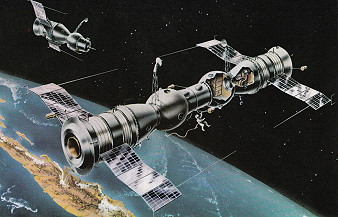
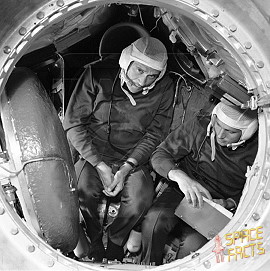
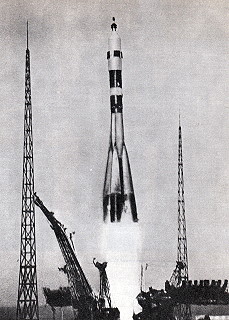
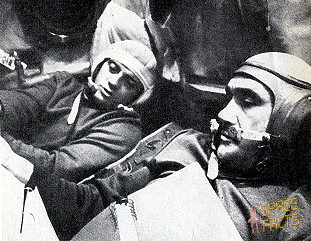
landing 155 km northwest of Karaganda. The main goals of this mission in the official version were to test spacecraft systems and designs, maneuvering of space craft with respect to each other in orbit, and to conduct scientific, technical and medico-biological experiments in a group flight. The real main goal was the first simultaneous flight of three manned spacecraft. It was to get the spacecraft rendezvoused with Soyuz 7 and Soyuz 8 and to have taken spectacular motion pictures of the Soyuz 7 - Soyuz 8 docking. Soyuz 6 was launched on October 11, 1969. The cosmonauts tested the spacecraft systems and designs, maneuvering of space craft with respect to each other in orbit, conducted scientific, technical and medico-biological experiments in group flight. On October 12, 1969 Soyuz 7 followed to orbit. As third spacecraft Soyuz 8 was launched on October 13, 1969. It became a joint mission of three spacecraft of Soyuz 6, Soyuz 7 and Soyuz 8. There were plans to get Soyuz 7 docked with Soyuz 8 and transfer at least one cosmonaut by a spacewalk while Soyuz 6 took film from nearby. A confirmation about a planned spacewalk was never given. Orbital maneuvers for the Soyuz 7-Soyuz 8 docking had proceeded normally. The automated rendezvous system was supposed to kick in when the spacecraft are 250 km apart. The plan was that Soyuz 7 and Soyuz 8 dock while Soyuz 6 observes from only 50 m away. However, when Soyuz 7 and Soyuz 8 were only a kilometer apart, the Igla automated docking system failed. The crews could conduct a manual rendezvous, but this is not allowed by the technical flight controller. Following an orbital correction during the night, Soyuz 7 and Soyuz 8 were expected to be less than 1 km from each other when communications are regained at 9 am. Instead they are 40 km apart. It will require two more orbits over Soviet territory to refine the tracking of the spacecraft and recalculate the necessary rendezvous maneuvers. By 12:40 they are 1700 m apart and the crews began the manual rendezvous maneuver. Vladimir Shatalov fired his engines four times, but in the absence of any indication to the pilot of range to the target, he could not get into a position for a safe docking. He withdrawed to a safe distance. After the landing of Soyuz 6 there are two further attempts to dock Soyuz 7 and Soyuz 8, but they fail due to large errors in the ballistic calculations of the maneuvers necessary to correct their orbits. So, no rendezvous, due to a failure in the rendezvous electronics in all three spacecraft was carried out. So, there was only an approaching. It is still not known exactly what the actual problem was, but it is often quoted as being a helium pressurization integrity test. The version of Soyuz 7K-OK spacecraft used for the missions carried a torus shaped docking electronics equipment housing surrounding the motor assembly on the back of the service module. This is thought to have been pressurized with helium to provide a benign environment for the electronics. It was then jettisoned after docking to lower the mass of the spacecraft for reentry. What went wrong with the electronics on all three spacecraft is still not known. Several scientific and technical experiments were also performed. The Soyuz spacecraft is composed of three elements attached end-to-end - the Orbital Module, the Descent Module and the Instrumentation/Propulsion Module. The crew occupied the central element, the Descent Module. The other two modules are jettisoned prior to re-entry. They burn up in the atmosphere, so only the Descent Module returned to Earth. The deorbit burn lasted 188 seconds. Having shed two-thirds of its mass, the Soyuz reached Entry Interface - a point 400,000 feet (121.9 kilometers) above the Earth, where friction due to the thickening atmosphere began to heat its outer surfaces. With only 23 minutes left before it lands on the grassy plains of central Asia, attention in the module turned to slowing its rate of descent. Eight minutes later, the spacecraft was streaking through the sky at a rate of 755 feet (230 meters) per second. Before it touched down, its speed slowed to only 5 feet (1.5 meter) per second, and it lands at an even lower speed than that. Several onboard features ensure that the vehicle and crew land safely and in relative comfort. Four parachutes, deployed 15 minutes before landing, dramatically slowed the vehicle's rate of descent. Two pilot parachutes were the first to be released, and a drogue chute attached to the second one followed immediately after. The drogue, measuring 24 square meters (258 square feet) in area, slowed the rate of descent from 755 feet (230 meters) per second to 262 feet (80 meters) per second. The main parachute was the last to emerge. It is the largest chute, with a surface area of 10,764 square feet (1,000 square meters). Its harnesses shifted the vehicle's attitude to a 30-degree angle relative to the ground, dissipating heat, and then shifted it again to a straight vertical descent prior to landing. The main chute slowed the Soyuz to a descent rate of only 24 feet (7.3 meters) per second, which is still too fast for a comfortable landing. One second before touchdown, two sets of three small engines on the bottom of the vehicle fired, slowing the vehicle to soften the landing. The landing was without any problems, even a warning light panel showed 'ASP' - automatic landing sequence. |
Photos / Graphics
 |
 |
|
source of all photos is Roscosmos / TASS |
|
 |
 |
 |
 |
 |
 |
| © |  |
Last update on January 26, 2022.  |
 |