Human Orbital Spaceflights

International Flight No. 51Soyuz 16BuranUSSR |
 |
Launch, orbit and landing data
walkout photo |
 |
|||||||||||||||||||
alternative crew photo |
alternative crew photo |
|||||||||||||||||||
alternative crew photo |
alternative crew photo |
|||||||||||||||||||
alternative crew photo |
alternative crew photo |
|||||||||||||||||||
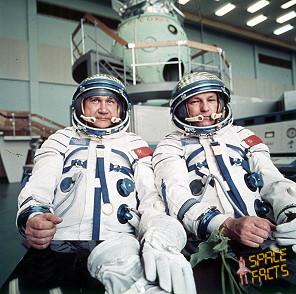
Crew
| No. | Surname | Given names | Position | Flight No. | Duration | Orbits | |
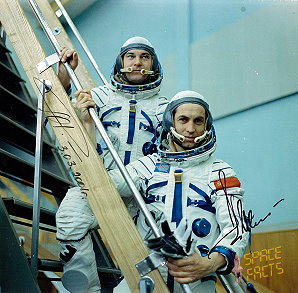
| 1 |  |
Filipchenko | Anatoli Vasiliyevich | Commander | 2 | 5d 22h 23m 35s | 97 |
| 2 | |
Rukavishnikov | Nikolai Nikolayevich | Flight Engineer | 2 | 5d 22h 23m 35s | 97 |
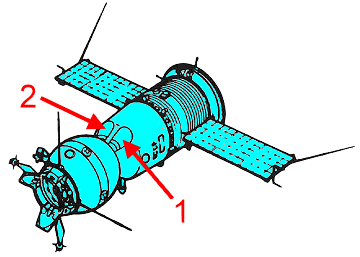
Crew seating arrangement
|
 |
|
||||||||||||
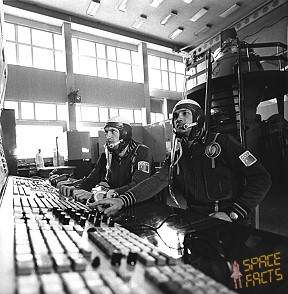
1st Backup Crew
|
 |
2nd Backup Crew
|
 |
|||||||||||||||
Hardware
| Launch vehicle: | Soyuz-U (No. K15000-14) |
| Spacecraft: | Soyuz 16 (7K-TM No. 73) |
Flight
|
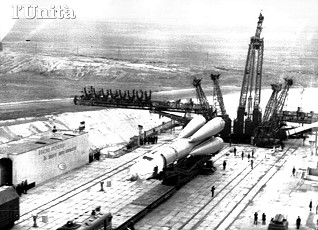
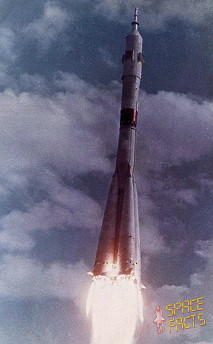
Launch from the Baikonur Cosmodrome and
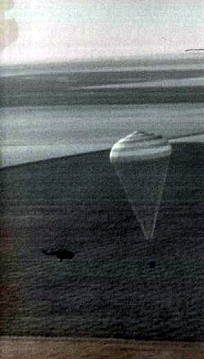
landing 300 km north of Dzheskasgan / 30 km southwest of Arkalyk. The Soyuz 16 mission was the final rehearsal and first manned mission in a program which culminated in the Apollo-Soyuz (ASTP) mission seven months later. Main goals of the mission were check-out of the Soyuz space craft's on-board systems which had been modernized to meet the requirements of the 1975 joint flight in accordance with the programme of the Soviet-United States experiment; conduct of scientific and technical investigations. Early concepts for a joint flight included docking a Soyuz craft to the American Skylab space station, or an Apollo vehicle docking with a Salyut space station. Once the Americans abandoned their Skylab station in 1974, the Apollo-Salyut concept seemed to be the logical choice, but since the Soviets had started to develop a universal docking adapter for the mission and feared having to publicly reveal details of their military-focused Salyut missions, the two powers opted to link a Soyuz spacecraft with an Apollo spacecraft. During the flight, cosmonauts Anatoli Filipchenko and Nikolai Rukavishnikov tested the androgynous docking system to be used for the ASTP mission by retracting and extending a simulated 20 kg American docking ring. The crew also tested modified environmental systems, new solar panels and improved control systems, as well as a new radar docking system. The air pressure was reduced from 760 mm to 540 mm and oxygen raised from 20% to 40% to test reducing the planned transfer time to Apollo from two to one hour. On December 07, 1974, the docking ring was jettisoned with explosive bolts to test emergency measures if the capture latches got stuck during the ASTP flight. From launch to landing the flight of Soyuz was nearly perfect, and the results of the test of life support, docking, antenna deployment, and ground control systems were excellent. The Soyuz spacecraft is composed of three elements attached end-to-end - the Orbital Module, the Descent Module and the Instrumentation/Propulsion Module. The crew occupied the central element, the Descent Module. The other two modules are jettisoned prior to re-entry. They burn up in the atmosphere, so only the Descent Module returned to Earth. The deorbit burn lasted 188 seconds. Having shed two-thirds of its mass, the Soyuz reached Entry Interface - a point 400,000 feet (121.9 kilometers) above the Earth, where friction due to the thickening atmosphere began to heat its outer surfaces. With only 23 minutes left before it lands on the grassy plains of central Asia, attention in the module turned to slowing its rate of descent. Eight minutes later, the spacecraft was streaking through the sky at a rate of 755 feet (230 meters) per second. Before it touched down, its speed slowed to only 5 feet (1.5 meter) per second, and it lands at an even lower speed than that. Several onboard features ensure that the vehicle and crew land safely and in relative comfort. Four parachutes, deployed 15 minutes before landing, dramatically slowed the vehicle's rate of descent. Two pilot parachutes were the first to be released, and a drogue chute attached to the second one followed immediately after. The drogue, measuring 24 square meters (258 square feet) in area, slowed the rate of descent from 755 feet (230 meters) per second to 262 feet (80 meters) per second. The main parachute was the last to emerge. It is the largest chute, with a surface area of 10,764 square feet (1,000 square meters). Its harnesses shifted the vehicle's attitude to a 30-degree angle relative to the ground, dissipating heat, and then shifted it again to a straight vertical descent prior to landing. The main chute slowed the Soyuz to a descent rate of only 24 feet (7.3 meters) per second, which is still too fast for a comfortable landing. One second before touchdown, two sets of three small engines on the bottom of the vehicle fired, slowing the vehicle to soften the landing. |
Photos
 |
 |
|
source of all photos is Roscosmos / TASS |
|
 |
 |
 |
 |
| © |  |
Last update on March 28, 2020.  |
 |