Human Orbital Spaceflights

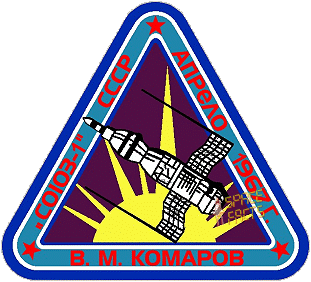
International Flight No. 23Soyuz 1RubyUSSR |
 |
Launch, orbit and landing data
walkout photo |
 |
Crew
| No. | Surname | Given names | Position | Flight No. | Duration | Orbits | |
| 1 |  |
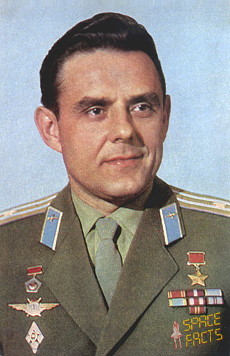
Komarov | Vladimir Mikhailovich | Commander | 2 | 1d 02h 47m 52s | 18 |
Crew seating arrangement
|
 |
|
||||||||
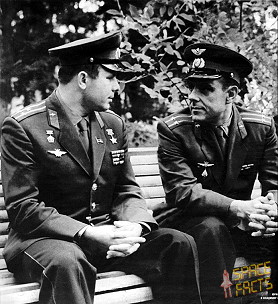
Backup Crew
 |
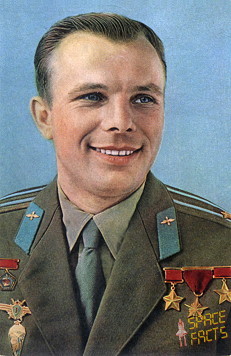 |
Hardware
| Launch vehicle: | Soyuz (No. U15000-03) |
| Spacecraft: | Soyuz 1 (7K-OK No. 4) |
Flight
|
Launch from the Baikonur Cosmodrome and
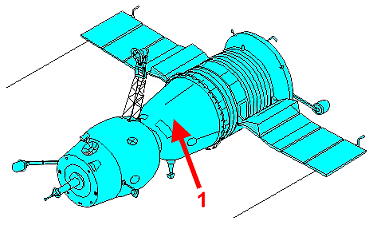
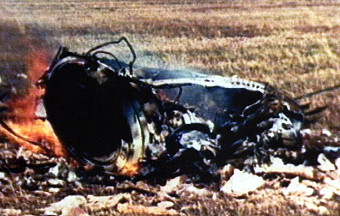
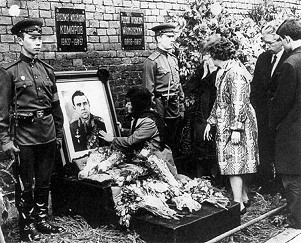
landing near Orenburg (40 km from Novoorsk / 3 km of Karabutak). Prior to launch, Soyuz 1 engineers are said to have reported 203 design faults to party leaders, but their concerns were overruled by political pressures for a series of space feats to mark the anniversary of Lenin's birthday. It is not clear how much of this pressure resulted from the need to continue beating the United States in the Space Race and have Soviets first on the Moon, or to take advantage of the recent setbacks in the U.S. space program. This mission was the first manned test of the new developed Soyuz spacecraft. It was planned, that a second Soyuz spacecraft should be launched shortly after Soyuz 1 and that two cosmonauts of Soyuz 2 should travel in space from one spacecraft to another. But the launch of Soyuz 2 was officially scrubbed due to heavy rain over Baikonur. The problems in this mission began shortly after the launch. A solar panel could not be unfolded and so the spacecraft had a shortage of power for its systems. The spacecraft also could not be maneuvered (problems with orientation detectors). Later on, the stabilization system was down and the manual system could be used only partially. So, the mission was aborted and that may probably the reason, why Soyuz 2 never launched. The Soyuz spacecraft is composed of three elements attached end-to-end - the Orbital Module, the Descent Module and the Instrumentation/Propulsion Module. The crew occupied the central element, the Descent Module. The other two modules are jettisoned prior to re-entry. They burn up in the atmosphere, so only the Descent Module returned to Earth. The deorbit burn lasted 188 seconds. Having shed two-thirds of its mass, the Soyuz reached Entry Interface - a point 400.000 feet (121.9 kilometer) above the Earth, where friction due to the thickening atmosphere began to heat its outer surfaces. With only 23 minutes left before it lands on the grassy plains of central Asia, attention in the module turned to slowing its rate of descent. Eight minutes later, the spacecraft was streaking through the sky at a rate of 755 feet (230 meters) per second. Before it touched down, its speed slowed to only 5 feet (1.5 meter) per second, and it lands at an even lower speed than that. Several onboard features ensure that the vehicle and crew land safely and in relative comfort. Four parachutes, planned to deploy 15 minutes before landing, dramatically should slow the vehicle's rate of descent. The problems onboard ended in a precipitated landing. The first automatically controlled retrofire in the 16th orbit failed, so Vladimir Komarov tried it again (successful) in the 18th orbit. Although Vladimir Komarov had only little control, he might have survived, but the main parachute, which was put out in a height of 6.5 km did not deploy due to a failure of a pressure sensor and the manually deployed reserve chute became tangled with the drag chute. As a result, the Soyuz reentry module fell to Earth in Orenburg Oblast almost entirely unimpeded, at about 40 m/s (140 km/h; 89 mph); Vladimir Komarov died on impact. At impact there was an explosion and an intense fire that engulfed the capsule. Local farmers rushed to try to put it out. It is told, that his dispairing calls for help have been heard from western radio amateurs. This seems to be wrong. At the moment when the reserve chute did not deploy and Vladimir Komarov recognized that he will not survive, the spacecraft was only 6.000 meters above the ground. At this point FM broadcasting transmissions were not able to receive in foreign countries. |
Photos
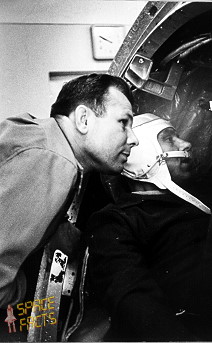 |
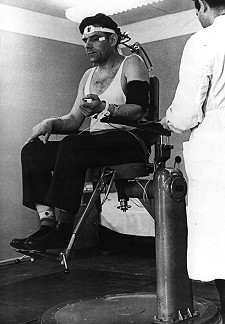 |
|
source of all photos is Roscosmos / TASS |
|
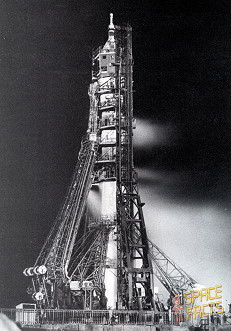 |
 |
 |
 |
| © |  |
Last update on August 12, 2020.  |
 |