Human Spaceflights to the Moon

International Flight No. 38Apollo 14USA |
 |
 |
Launch, orbit and landing data
walkout photo |
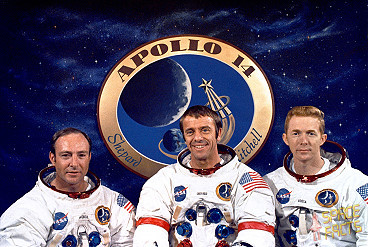 |
|||||||||||||||||||||||||||||||
alternative crew photo |
alternative crew photo |
|||||||||||||||||||||||||||||||
alternative crew photo |
alternative crew photo |
|||||||||||||||||||||||||||||||
alternative crew photo |
||||||||||||||||||||||||||||||||
Crew
| No. | Surname | Given names | Position | Flight No. | Duration | Orbits | |
| 1 |  |
Shepard | Alan Bartlett, Jr. "Al" | CDR | 1 | 9d 00h 01m 57s | 1,5 |
| 2 | |
Roosa | Stuart Allen "Stu" | CMP | 1 | 9d 00h 01m 57s | 1,5 |
| 3 | |
Mitchell | Edgar Dean "Ed" | LMP | 1 | 9d 00h 01m 57s | 1,5 |
Crew seating arrangement
|
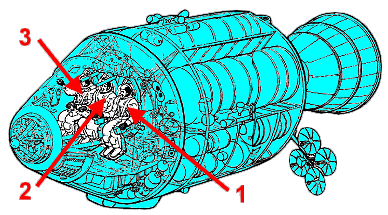 |
|
||||||||||||||||
Backup Crew
|
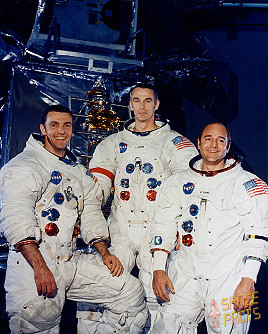
alternative crew photo |
|||||||||||||||||||||
 |
||||||||||||||||||||||
Support Crew
|
|||||||||||||
Hardware
| Launch vehicle: | Saturn V (SA-509) |
| Spacecraft: | Apollo (CSM-110 „Kitty Hawk“ / LM-8 „Antares“) |
Flight
|
Launch from Cape Canaveral (KSC). The
launch was delayed for the first time in the
Apollo history for about 40 minutes due to bad
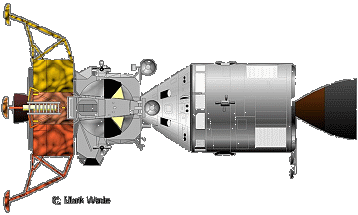
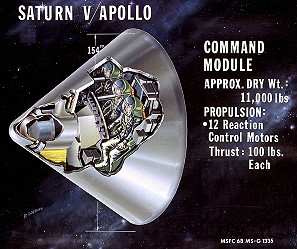
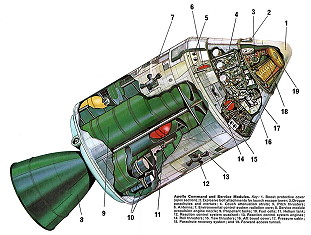
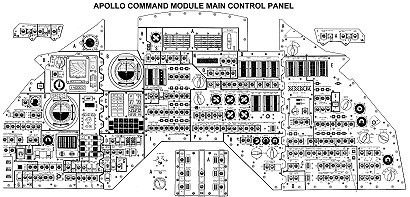
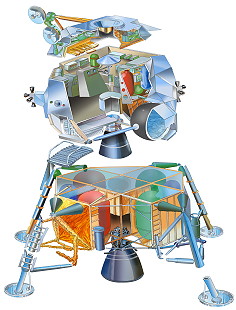
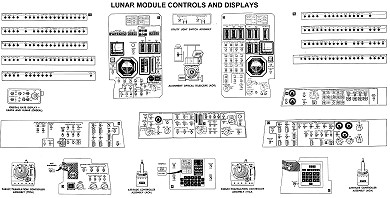
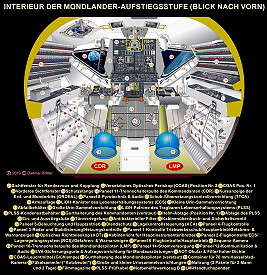
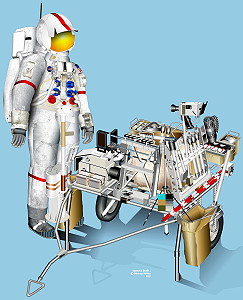
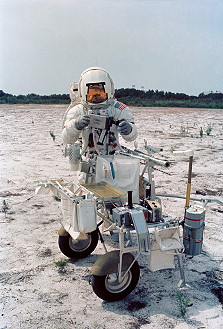
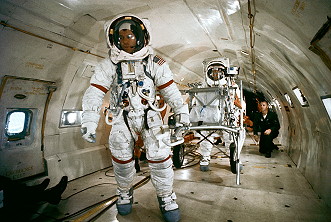
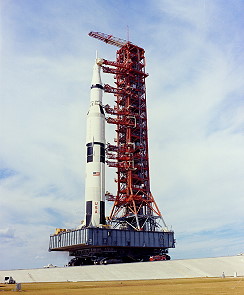
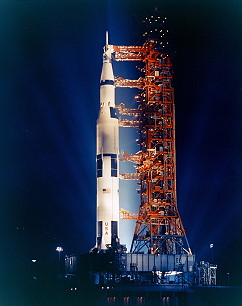
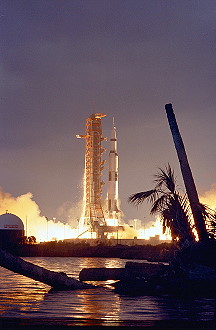
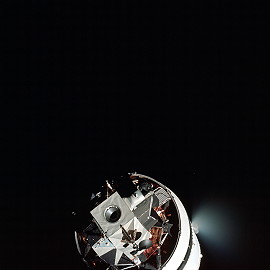
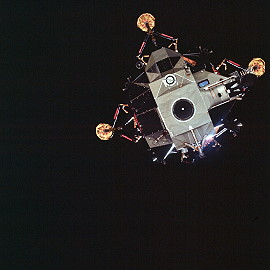
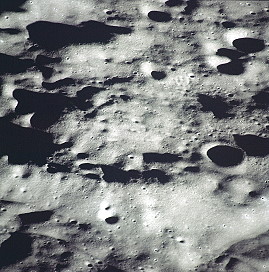
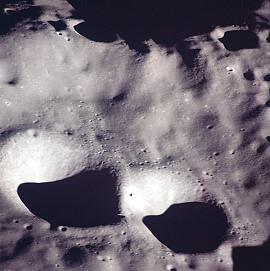
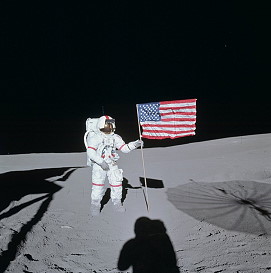
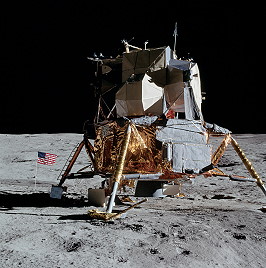
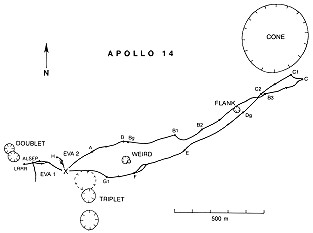
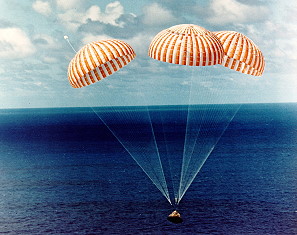
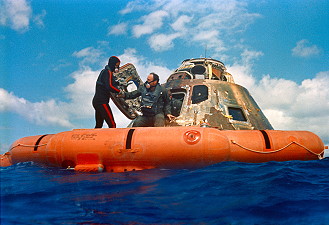
weather. The landing was near of Samoa Island in the Pacific Ocean. The Command Module (CM) was a conical pressure vessel with a maximum diameter of 3.9 m at its base and a height of 3.65 m. It was made of an aluminum honeycomb sandwich bonded between sheet aluminum alloy. The base of the CM consisted of a heat shield made of brazed stainless steel honeycomb filled with a phenolic epoxy resin as an ablative material and varied in thickness from 1.8 to 6.9 cm. At the tip of the cone was a hatch and docking assembly designed to mate with the lunar module. The CM was divided into three compartments. The forward compartment in the nose of the cone held the three 25.4 m diameter main parachutes, two 5 m drogue parachutes, and pilot mortar chutes for Earth landing. The aft compartment was situated around the base of the CM and contained propellant tanks, reaction control engines, wiring, and plumbing. The crew compartment comprised most of the volume of the CM, approximately 6.17 cubic meters of space. Three astronaut couches were lined up facing forward in the center of the compartment. A large access hatch was situated above the center couch. A short access tunnel led to the docking hatch in the CM nose. The crew compartment held the controls, displays, navigation equipment and other systems used by the astronauts. The CM had five windows: one in the access hatch, one next to each astronaut in the two outer seats, and two forward-facing rendezvous windows. Five silver/zinc-oxide batteries provided power after the CM and SM detached, three for re-entry and after landing and two for vehicle separation and parachute deployment. The CM had twelve 420 N nitrogen tetroxide/hydrazine reaction control thrusters. The CM provided the re-entry capability at the end of the mission after separation from the Service Module. The Service Module (SM) was a cylinder 3.9 meters in diameter and 7.6 m long which was attached to the back of the CM. The outer skin of the SM was formed of 2.5 cm thick aluminum honeycomb panels. The interior was divided by milled aluminum radial beams into six sections around a central cylinder. At the back of the SM mounted in the central cylinder was a gimbal mounted re-startable hypergolic liquid propellant 91,000 N engine and cone shaped engine nozzle. Attitude control was provided by four identical banks of four 450 N reaction control thrusters each spaced 90 degrees apart around the forward part of the SM. The six sections of the SM held three 31-cell hydrogen oxygen fuel cells which provided 28 volts, two cryogenic oxygen and two cryogenic hydrogen tanks, four tanks for the main propulsion engine, two for fuel and two for oxidizer, and the subsystems the main propulsion unit. Two helium tanks were mounted in the central cylinder. Electrical power system radiators were at the top of the cylinder and environmental control radiator panels spaced around the bottom. The lunar module (LM) was a two-stage vehicle designed for space operations near and on the Moon. The spacecraft mass of 15,065 kg was the mass of the LM including astronauts, propellants and expendables. The dry mass of the ascent stage was 2180 kg and it held 2639 kg of propellant. The descent stage dry mass was 2034 kg and 8212 kg of propellant were onboard initially. The ascent and descent stages of the LM operated as a unit until staging, when the ascent stage functioned as a single spacecraft for rendezvous and docking with the command and service module (CSM). The descent stage comprised the lower part of the spacecraft and was an octagonal prism 4.2 meters across and 1.7 m thick. Four landing legs with round footpads were mounted on the sides of the descent stage and held the bottom of the stage 1.5 m above the surface. The distance between the ends of the footpads on opposite landing legs was 9.4 m. One of the legs had a small astronaut egress platform and ladder. A one meter long conical descent engine skirt protruded from the bottom of the stage. The descent stage contained the landing rocket, two tanks of aerozine 50 fuel, two tanks of nitrogen tetroxide oxidizer, water, oxygen and helium tanks and storage space for the lunar equipment and experiments, and in the case of Apollo 15, 16, and 17, the lunar rover. The descent stage served as a platform for launching the ascent stage and was left behind on the Moon. The ascent stage was an irregularly shaped unit approximately 2.8 m high and 4.0 by 4.3 meters in width mounted on top of the descent stage. The ascent stage housed the astronauts in a pressurized crew compartment with a volume of 6.65 cubic meters which functioned as the base of operations for lunar operations. There was an ingress-egress hatch in one side and a docking hatch for connecting to the CSM on top. Also mounted along the top were a parabolic rendezvous radar antenna, a steerable parabolic S-band antenna, and 2 in-flight VHF antennas. Two triangular windows were above and to either side of the egress hatch and four thrust chamber assemblies were mounted around the sides. At the base of the assembly was the ascent engine. The stage also contained an aerozine 50 fuel and an oxidizer tank, and helium, liquid oxygen, gaseous oxygen, and reaction control fuel tanks. There were no seats in the LM. A control console was mounted in the front of the crew compartment above the ingress-egress hatch and between the windows and two more control panels mounted on the side walls. The ascent stage was launched from the Moon at the end of lunar surface operations and returned the astronauts to the CSM. The descent engine was a deep-throttling ablative rocket with a maximum thrust of about 45,000 N mounted on a gimbal ring in the center of the descent stage. The ascent engine was a fixed, constant-thrust rocket with a thrust of about 15,000 N. Maneuvering was achieved via the reaction control system, which consisted of the four thrust modules, each one composed of four 450 N thrust chambers and nozzles pointing in different directions. Telemetry, TV, voice, and range communications with Earth were all via the S-band antenna. VHF was used for communications between the astronauts and the LM, and the LM and orbiting CSM. There were redundant transceivers and equipment for both S-band and VHF. An environmental control system recycled oxygen and maintained temperature in the electronics and cabin. Power was provided by 6 silver-zinc batteries. Guidance and navigation control were provided by a radar ranging system, an inertial measurement unit consisting of gyroscopes and accelerometers, and the Apollo guidance computer. The Apollo Lunar Surface Experiments Package (ALSEP) consisted of a set of scientific instruments emplaced at the landing site by the astronauts. The instruments were arrayed around a central station which supplied power to run the instruments and communications so data collected by the experiments could be relayed to Earth. The central station was a 25 kg box with a stowed volume of 34,800 cubic cm. Thermal control was achieved by passive elements (insulation, reflectors, thermal coatings) as well as power dissipation resistors and heaters. Communications with Earth were achieved through a 58 cm long, 3.8 cm diameter modified axial-helical antenna mounted on top of the central station and pointed towards Earth by the astronauts. Transmitters, receivers, data processors and multiplexers were housed within the central station. Data collected from the instruments were converted into a telemetry format and transmitted to Earth. The ALSEP system and instruments were controlled by commands from Earth. The SNAP-27 model RTG produced the power to run the ALSEP operations. The generator consisted of a 46 cm high central cylinder and eight radiating rectangular fins with a total tip-to-tip diameter of 40 cm. The central cylinder had a thinner concentric inner cylinder inside, and the two cylinders were attached along their surfaces by 442 spring-loaded lead-telluride thermoelectric couples mounted radially along the length of the cylinders. The generator assembly had a total mass of 17 kg. The power source was an approximately 4 kg fuel capsule in the shape of a long rod which contained plutonium-238 and was placed in the inner cylinder of the RTG by the astronauts on deployment. Plutonium-238 decays with a half-life of 89.6 years and produces heat. This heat would conduct from the inner cylinder to the outer via the thermocouples which would convert the heat directly to electrical power. Excess heat on the outer cylinder would be radiated to space by the fins. The RTG produced approximately 70 W DC at 16 V. (63.5 W after one year.) The electricity was routed through a cable to a power conditioning unit and a power distribution unit in the central station to supply the correct voltage and power to each instrument. The Modularized Equipment Transporter (MET) was a two-wheeled vehicle with a tubular structure 86 inches (218 centimeters) long, 39 inches (99 centimeters) wide and 32 inches (81 centimeters) high when deployed ready to use on the lunar surface. The MET had a single handle for towing and has two legs to provide four-point stability at rest. The MET was stowed during flight in the Modularized Equipment Storage Assembly (MESA) in the LM descent stage, and was used during both EVAs. Equipment was mounted on the MET for the geology traverse included the lunar hand tool carrier and the geology tools it carried, the closeup stereo camera, two 70 mm Hasselblad cameras, a 16 mm data acquisition camera, film magazines, a dispenser for sample bags, a trenching tool, work table, sample weigh bags and the Lunar Portable Magnetometer. The MET tires were 4 inches (10.1 centimeters) wide and 16 inches (40.6 centimeters) in diameter, and were inflated with 1.5 psi nitrogen preflight. The tires were baked at 250 degrees F (121 degrees Celsius) for 24 hours preflight to remove most of the antioxidants in the rubber. Operating limits for the MET tires are -70 deg. F (-57 degrees Celsius) to +250 deg. F (121 degrees Celsius). Empty weight of the MET was 26 pounds (11.8 kilograms), and the vehicle had a useful payload of about 140 pounds = 63.5 kilograms (Earth weight) including the lunar soil samples to be brought back to the LM from the geology traverse. Estimated travel rate of a crewman towing the MET, as determined by tests with the 1/6-g centrifuge rig at MSC, was about 3.5 feet per second (1.07 meters per second), with a one pound of pull required on level sand. After a delay of 40 minutes, 2 seconds due to clouds and rain, Apollo 14 was launched into Earth parking orbit on January 31, 1971 at 21:03:02 UTC from pad 39-A of Kennedy Space Center on Saturn V SA-509. Earth orbit insertion occurred at 21:14:51 UTC followed by translunar injection at 23:37:34 UTC. An early first mid-course correction was made to make up for the launch delay so the spacecraft would arrive at the Moon on schedule. At the beginning of the mission, the CSM Kitty Hawk had difficulty achieving capture and docking with the LM Antares. Repeated attempts to dock went on for 1 hour and 42 minutes, until it was suggested that pilot Stuart Roosa hold Kitty Hawk against Antares using its thrusters, then the docking probe would be retracted out of the way, hopefully triggering the docking latches. This attempt was successful, and no further docking problems were encountered during the mission. After separating from the command module in lunar orbit, the LM Antares also had two serious problems. First, the LM computer began getting an ABORT signal from a faulty switch. NASA believed that the computer might be getting erroneous readings like this if a tiny ball of solder had shaken loose and was floating between the switch and the contact, closing the circuit. The immediate solution - tapping on the panel next to the switch - did work briefly, but the circuit soon closed again. If the problem recurred after the descent engine fired, the computer would think the signal was real and would initiate an auto-abort, causing the Ascent Stage to separate from the Descent Stage and climb back into orbit. NASA and the software teams at MIT scrambled to find a solution, and determined the fix would involve reprogramming the flight software to ignore the false signal. The software modifications were transmitted to the crew via voice communication, and Edgar Mitchell manually entered the changes (amounting to over 80 keystrokes on the LM computer pad) just in time. The LM, with Alan Shepard and Edgar Mitchell aboard, separated from the CSM, piloted by Stuart Roosa, at 04:50:44 UTC on February 05, 1971 and landed at 09:18:11 UTC in the hilly upland region 24 km north of the rim of Fra Mauro crater at 3.6 S, 17.5 W. A second problem occurred during the powered descent, when the LM radar altimeter failed to lock automatically onto the moon's surface, depriving the navigation computer of vital information on the vehicle altitude and groundspeed. This was later determined to be an unintended consequence of the software patch. After the astronauts cycled the landing radar breaker, the unit successfully acquired a signal near 18,000 feet (5,500 m), again just in the nick of time. Alan Shepard then manually landed the LM closer to its intended target than any of the other six moon landing missions. Edgar Mitchell believes that Alan Shepard would have continued with the landing attempt without the radar, using the LM inertial guidance system and visual cues. But a post-flight review of the descent data showed the inertial system alone would have been inadequate, and the astronauts probably would have been forced to abort the landing as they approached the surface. The crew performed the third manned moon landing. The landing site was Fra Mauro. Alan Shepard's moonwalking suit was the first to utilize red bands on the arms and legs and a red stripe on the top of the lunar EVA sunshade "hood", so as to allow easy identification of the commander while on the surface. Two EVAs were performed by Alan Shepard and Edgar Mitchell. The first EVA occurred on February 05, 1971 (4h 48m). Alan Shepard stepped onto the Moon and described the surface as "so soft that it comes all the way to the top of the [LM] footpads; it's even folded over the sides to some degree. . ." Looking ahead to the second EVA, which would include a climb to the rim of Cone Crater, he added that "it looks as though we have a good traverse route up to the top of the Cone." After Edgar Mitchell joined Alan Shepard on the surface, the astronauts collected a 19.5-kg (42.9-lb) contingency sample, then deployed the TV camera (taking care not to point it at the Sun), S-band dish antenna, and U.S. flag. A hinged center shade section was added to the EVA, providing additional eye protection when the astronaut walked toward the Sun under low Sun-angle conditions. The astronauts deployed the ALSEP experiments about 150 m (495 ft) west of Antares, then set up the laser ranging retroreflector 30 m (100 ft) beyond that. The EVA was extended by 30 minutes to partly compensate for the late start. In all, the astronauts covered about 550 m (1815 ft) before returning to Antares to eat and rest. The second EVA occurred on February 06, 1971 (4h 34m). The second moonwalk was intended to reach the rim of the 1,000-foot (300 m) wide Cone Crater. However, the two astronauts were not able to find the rim amid the rolling terrain of the crater's slopes. Later analysis, using the pictures that they took, determined that they had come within an estimated 65 feet (20 m) of the crater's rim. Images from the Lunar Reconnaissance Orbiter (LRO) show the tracks of the astronauts and the MET come to within 30 m of the rim. Alan Shepard and Edgar Mitchell deployed and activated various scientific instruments and experiments and collected almost 100 pounds (45 kg) of lunar samples for return to earth. Other Apollo 14 achievements included: the only use of MET; longest distance traversed by foot on the lunar surface; first use of shortened lunar orbit rendezvous techniques; and the first extensive orbital science period conducted during CSM solo operations. The MET had a tendency to tip and became difficult to pull as the number of boulders increased. Alan Shepard and Edgar Mitchell finally resorted to carrying it. Edgar Mitchell noted problems with dust, saying that, "we're filthy as pigs. . . everything's going to be covered with dust before long." Alan Shepard's heart rate climbed to 150 beats per min and Edgar Mitchell's right EMU wrist cable broke, impeding his hand movements. Alan Shepard said after the EVA, however, that the worst problem was "the undulating terrain where you simply couldn't see more than 100 to 150 yards [90 to 135 m] away from you. Consequently, you were never quite sure what landmark would appear when you topped the next ridge. We were very surprised when we. . . approached the ridge which we thought to be the rim of Cone Crater, to find there was another one behind it. . . I think if we had wanted to reach the top of the crater and did nothing else, that we could have done that within the time period allotted." The astronauts received a 30-minutes extension, but were finally compelled to abandon their quest for the rim. They obtained only one of three planned core tubes, 16 photographs, and 10 kg (22 lb) of samples during their Cone traverse. The astronauts also engaged in less serious activities on the Moon. Alan Shepard smuggled on board a six iron golf club head which he could attach to the handle of a lunar excavation tool, and two golf balls, and took several one-handed swings (due to the limited flexibility of the EVA suit). He exuberantly exclaimed that the second ball went "miles and miles and miles" in the low lunar gravity, but later estimated the distance as 200 to 400 yards (180 to 370 m). Edgar Mitchell then threw a lunar scoop handle as if it were a javelin. During that time astronaut Stuart Roosa, orbiting the moon in the CSM Kitty Hawk, took astronomy and lunar photos, including photos of the proposed Descartes landing site for Apollo 16. The LM lifted off from the Moon at 18:48:42 UTC on February 06, 1971 after 33 hours, 31 minutes on the lunar surface. After the LM docked with the CSM at 20:35:53 UTC the lunar samples and other equipment were transferred from the LM and the LM was jettisoned at 22:48:00 UTC. It impacted the Moon on February 08, 1971 00:45:25.7 UTC at 3.42 S, 19.67 W. Trans-Earth injection began at 01:39:04 UTC on February 07, 1971. One small mid-course correction was made on February 08, 1971 during trans-Earth coast. The reentry was without any problems and they came down about 7 kilometers far from the recovery ship USS New Orleans. The Apollo 14 astronauts were the last lunar explorers to be quarantined on their return from the Moon. |
EVA data
| Name | Start | End | Duration | Mission | Airlock | Suit | Stripes | |
| EVA | Shepard, Alan | 05.02.1971, 14:42 UTC | 05.02.1971, 19:30 UTC | 4h 48m | Apollo 14 | LM Antares | A7L No. 90 | red |
| EVA | Mitchell, Edgar | 05.02.1971, 14:42 UTC | 05.02.1971, 19:30 UTC | 4h 48m | Apollo 14 | LM Antares | A7L No. 73 | without |
| EVA | Shepard, Alan | 06.02.1971, 08:11 UTC | 06.02.1971, 12:46 UTC | 4h 35m | Apollo 14 | LM Antares | A7L No. 90 | red |
| EVA | Mitchell, Edgar | 06.02.1971, 08:11 UTC | 06.02.1971, 12:46 UTC | 4h 35m | Apollo 14 | LM Antares | A7L No. 73 | without |
| IVA | Shepard, Alan | 06.02.1971, 13:22 UTC | 06.02.1971, 13:32 UTC | 0h 10m | Apollo 14 | LM Antares | A7L No. 90 | red |
| IVA | Mitchell, Edgar | 06.02.1971, 13:2 UTC | 06.02.1971, 13:32 UTC | 0h 10m | Apollo 14 | LM Antares | A7L No. 73 | without |
 |
Photos / Graphics
 |
 |
|
Source: www.astronautix.com/ |
|
 |
 |
 |
 |
 |
 |
|
source of all photos is NASA |
|
 |
 |
 |
 |
 |
 |
 |
 |
 |
 |
 |
 |
 |
 |
 |
|
more photos from the moon |
|
| © |  |
Last update on March 01, 2026.  |
 |