Resident Crews of the Mir

Mir: Expedition 6 |
 |

alternative crew photoalternative crew photoalternative crew photoalternative crew photo |
|
Crew, launch- and landing data
| No. | Nation | Surname | Given names | Position | Spacecraft (launch) |
Launch date |
Launch time |
Spacecraft (landing) |
Landing date |
Landing time |
Mission duration |
Orbits |
| 1 |  |
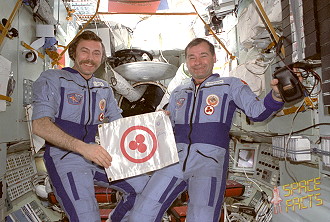
Soloviyov | Anatoli Yakovlevich | Commander | Soyuz TM-9 | 11.02.1990 | 06:16:00.000 UTC | Soyuz TM-9 | 09.08.1990 | 07:33:57 UTC | 179d 01h 17m 57s | 2833 |
| 2 | |
Balandin | Aleksandr Nikolayevich | Flight Engineer | Soyuz TM-9 | 11.02.1990 | 06:16:00.000 UTC | Soyuz TM-9 | 09.08.1990 | 07:33:57 UTC | 179d 01h 17m 57s | 2833 |
Backup Crew
| No. | Nation | Surname | Given names | Position |
| 1 | |
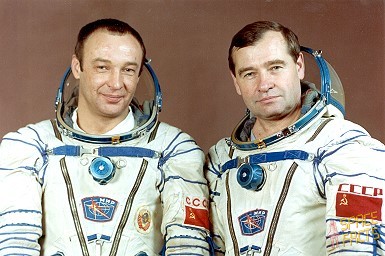
Manakov | Gennadi Mikhailovich | Commander |
| 2 | |
Strekalov | Gennadi Mikhailovich | Flight Engineer |
 |
alternative crew photo |
Expedition Report
|
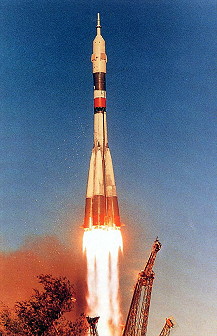
Launch from the Baikonur Cosmodrome and
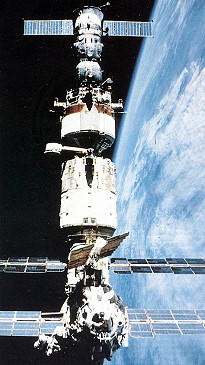
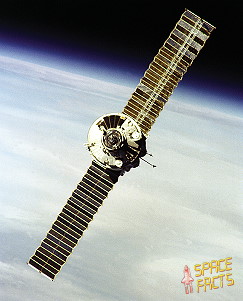
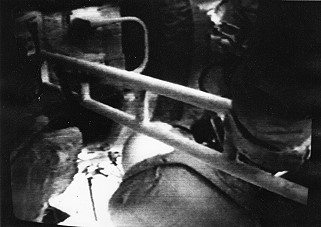
landing 72 km northeast of Arkalyk. Following a two-day solo flight Soyuz TM-9 docked with the Soyuz TM-8-Mir-Kvant-Kvant2 complex on February 13, 1990. The sixth resident crew takes turning the fifth resident crew. Soon after they arrived in orbit, Aleksandr Balandin and Anatoli Soloviyov noted that three of eight thermal insulation blankets on their spacecraft's descent module had come loose at their lower (heat shield) ends and were waving about as the spacecraft maneuvered in space. It was thought they could block optical navigation sensors, and that the damaged insulation might cause the spacecraft to overheat or cool down so much that condensation would form on its optical equipment. The possibility existed that an electrical short might occur if condensation developed on equipment. Docking with Mir occurred as normal. The cosmonauts and TsUP worked out procedures by which the TsUP monitored Soyuz TM-9's temperature and maneuvered Mir to move it in and out of sunlight as needed to maintain proper temperature. In the meantime, cosmonauts worked in the hydrolab training facility in Zvezdny Gorodok, outside Moscow, to develop EVA repair procedures. Consideration was also given to sending a rescue Soyuz-TM carrying a single cosmonaut to pick up the cosmonauts and return them to Earth. Three other areas of concern emerged: that the explosive bolts binding the service module to the descent module might fail to work after direct exposure to space, that the heat shield might be compromised by direct space exposure, and that an EVA to repair the blankets might cause additional damage. Consideration was given to flying Soyuz TM-10 with one cosmonaut aboard as a rescue mission. Progress M-3 arrived and remained docked with the station from March 03, 1990 - April 27, 1990. It delivered replacement parts for Mir, including new storage batteries, electrical system components, and computer parts. The cosmonauts began installing these by March 07, 1990. Most of March 1990 was taken up with work on the computer system. Supplies with several cargo spaceships of type Progress arrived at the station. The module Kristall (with food containers and the industrial processing units Krater 3, Optizon 1, Zona 02, and Zona 03.) docked with the station on June 10, 1990. From May 07, 1990 - May 27, 1990 Progress 42 occupied the aft port of Mir. This was the last of the highly successful series of Progress vehicles. It marked the 43rd Progress docking (counting Kosmos 1669), all of which were successful. The Progress freighters delivered 99 tons of material to Salyut 6, Salyut 7, and Mir. Use of Progress 42 forced a delay in the integration of the Salyut 5B control computer delivered with Kvant2, as Progress 42 could interface only with the old Argon 16B system. The long-awaited, much-delayed Kristall module arrived at Mir's front port on June 10, 1990 and was relocated to the lateral port opposite Kvant2 on the next day. This restored the equilibrium of the complex, which had been asymmetrical since Kvant2 was placed at a lateral port in December 1989. The Kristall module was launched May 31, 1990. It had aborted its first docking attempt on June 06, 1990 due to an attitude control thruster failure. Delays in launch and docking affected Aleksandr Balandin and Anatoli Soloviyov, who were scheduled to return to Earth at the end of July 1990. Their mission was extended 10 days to permit them to activate Kristall's systems, and to accommodate the EVA to repair the loose thermal blankets on Soyuz TM-9. Kristall was the third addition to the Mir core vehicle and was primarily designed to investigate materials processing technologies in the space environment. The module also supported biological, Earth observation and astrophysical research. It had a mass of 19.6 tons, a length of 11.9 meter, and a maximum diameter of 4.35 meter. Kristall was divided into an instrument/cargo and instrument/docking compartment, with 61 cubic meters of total pressurized volume. The instrument/cargo compartment held materials processing and biological experiments. The instrument/docking compartment held other investigations as well as a pair of docking ports. One of these ports was originally intended to support visits by the later cancelled Buran orbiter. Originally equipped with 2 solar panels (72 sq. m total area) that provided up to 8.4 kW (one moved to Kvant1 in 1995). Unlike the other solar panels on the Mir Complex, these could be folded or unfolded as a function of electrical power requirements. A 360 A-hr NiCd battery system provided energy storage. 2 3.9 kN main engines (NTO/UDMH) and clusters of 400N attitude control thrusters were used during the original docking process. The scientific payload consisted of: Krater 5, Optizon 1, CSK-1/Kristallizator semiconductor materials processing furnaces; Zona 2/3 materials processing furnaces; Glazar 2 UV telescope - cosmic radiation studies; Priroda 5 Earth resources camera system - consisted of 2 KFA-1000 film cameras; Svet plant cultivation unit; Mariya magnetic spectrometer; Marina gamma ray telescope; Buket gamma ray spectrometer; Granar astrophysics spectrometer; Ainur electrophoresis unit. Anatoli Soloviyov and Aleksandr Balandin had not previously been trained to perform an EVA. They trained by videotape sent up from the ground on a Progress spacecraft, and also by observing practice sessions televised from the hydrobasin. Special EVA tools were manufactured and sent to the cosmonauts. On July 03, 1990 they moved Soyuz TM-9 to the Mir front port so it could be more easily reached for repairs. The first EVA was performed on July 17, 1990 (7h 14m) in which spacecraft Soyuz TM-9 was repaired (three of the eight thermal blankets (layers of foil vacuum-shield insulation) on the descent module of the approaching Soyuz TM-9 spacecraft had come loose from their attachments near the heat shield, yet remained attached at their top ends). The hatch slammed back on its hinges. They used a pair of clamps, which they attached to handholds, to move down Kvant2. They also secured themselves with long and short ropes. After 1.5 hour they reached the multiport docking node. They attached to Kvant2 ladders for reaching the damage site on their Soyuz-TM. The cosmonauts determined that the Soyuz TM-9 descent module remained in excellent condition. However, the thermal blankets had shrunk, making them impossible to reattach. They fell back on a contingency plan by folding two of the three blankets in half. They were well behind schedule by this point. They left their tools and ladders at the repair site and hurried to return to Mir, as the rated endurance of their suits (6.5 hours) had been exceeded. This meant crawling over Kvant2's hull in the dark. They found that the Kvant2 hatch would not close. To permit them to re-enter the pressurized portion of Mir, the central compartment of Kvant2 was called into play as an emergency airlock, as it had been designed to do. Another EVA was performed on July 26, 1990 (3h 31m). Playback of the videotape made by Anatoli Soloviyov and Aleksandr Balandin and detailed post-EVA debriefing convinced engineers that Soyuz TM-9 was in excellent condition to return to Earth. Before the cosmonauts could safely undock, however, they had to remove ladders and tools they left near Soyuz TM-9 after their July 17, 1990 EVA. In addition, engineers wanted them to inspect the Kvant2 hatch. A Soviet state commission authorized the cosmonauts to work outside the station for up to 9 hours if required. On this date the cosmonauts depressurized the Kvant2 and moved through the unpressurized airlock into space. First they televised images of the damaged hatch to the TsUP. One hinge was obviously deformed. Then they moved to the Soyuz TM-9 worksite - more easily this time - and removed the ladders, stowing them on Kvant2's hull. Meanwhile, engineers in the TsUP sought a means of closing the hatch. Despite difficulty in gaining sufficient leverage, Aleksandr Balandin and Anatoli Soloviyov forced the hatch shut. They repressurized the SALC and ISC, sealed themselves in the latter, and doffed their suits, leaving the hatch to the airlock compartment closed. After 24 hours, the external airlock hatch showed no leakage, so the TsUP gave Anatoli Soloviyov and Aleksandr Balandin permission to leave open the hatch connecting the airlock to the rest of the station. On August 04, 1990, as Aleksandr Balandin and Anatoli Soloviyov handed off the station to the Mir-7 crew of Gennadi Strekalov and Gennadi Manakov, Radio Moscow World Service quoted former cosmonaut Vladimir Shatalov, head of the Cosmonaut Training Center at Star City, as saying that a single EVA would be sufficient to repair the hatch. Vladimir Shatalov said this in part to placate Mir's critics, who pointed out that repairs consumed much of the cosmonauts' time, decreasing time available for productive research. The crew conducted an extensive program of geophysical and astrophysical research, experiments on biology and biotechnology and work on space materials science. They started the commercial production of crystal in highest quality for an US electronic company. A protein grow experiment was also profitable (25 Million Rubel). The Mir-7 relief crew arrived aboard Soyuz TM-10 on August 03, 1990. The new crew arrived at Mir's aft port with four passengers - quail for cages in Kvant2. A quail laid an egg en route to the station. It was returned to Earth, along with 130 kg of experiment results and industrial products, in Soyuz TM-9. The Soyuz spacecraft is composed of three elements attached end-to-end - the Orbital Module, the Descent Module and the Instrumentation/Propulsion Module. The crew occupied the central element, the Descent Module. The other two modules are jettisoned prior to re-entry. They burn up in the atmosphere, so only the Descent Module returned to Earth. Having shed two-thirds of its mass, the Soyuz reached Entry Interface - a point 400,000 feet (121.9 kilometers) above the Earth, where friction due to the thickening atmosphere began to heat its outer surfaces. With only 23 minutes left before it lands on the grassy plains of central Asia, attention in the module turned to slowing its rate of descent. Eight minutes later, the spacecraft was streaking through the sky at a rate of 755 feet (230 meters) per second. Before it touched down, its speed slowed to only 5 feet (1.5 meter) per second, and it lands at an even lower speed than that. Several onboard features ensure that the vehicle and crew land safely and in relative comfort. Four parachutes, deployed 15 minutes before landing, dramatically slowed the vehicle's rate of descent. Two pilot parachutes were the first to be released, and a drogue chute attached to the second one followed immediately after. The drogue, measuring 24 square meters (258 square feet) in area, slowed the rate of descent from 755 feet (230 meters) per second to 262 feet (80 meters) per second. The main parachute was the last to emerge. It is the largest chute, with a surface area of 10,764 square feet (1,000 square meters). Its harnesses shifted the vehicle's attitude to a 30-degree angle relative to the ground, dissipating heat, and then shifted it again to a straight vertical descent prior to landing. The main chute slowed the Soyuz to a descent rate of only 24 feet (7.3 meters) per second, which is still too fast for a comfortable landing. One second before touchdown, two sets of three small engines on the bottom of the vehicle fired, slowing the vehicle to soften the landing. During reentry, the cosmonauts ejected both the orbital module and the service module simultaneously in an effort to minimize the chances that a blanket could snag. Normally the orbital module went first. The descent module suffered no damage as a result of its prolonged exposure to space conditions. The landing was without incident. |
EVA data
| Name | Start | End | Duration | Mission | Airlock | Suit | Stripes | |
| EVA | Balandin, Aleksandr | 17.07.1990, 13:06 UTC | 17.07.1990, 20:20 UTC | 7h 14m | Soyuz TM-9 | Mir - Kvant2 | Orlan-DMA No. 8 | blue |
| EVA | Soloviyov, Anatoli | 17.07.1990, 13:06 UTC | 17.07.1990, 20:20 UTC | 7h 14m | Soyuz TM-9 | Mir - Kvant2 | Orlan-DMA No. 12 | red |
| EVA | Soloviyov, Anatoli | 26.07.1990, 11:15 UTC | 26.07.1990, 14:46 UTC | 3h 31m | Soyuz TM-9 | Mir - Kvant2 | Orlan-DMA No. 12 | blue |
| EVA | Balandin, Aleksandr | 26.07.1990, 11:15 UTC | 26.07.1990, 14:46 UTC | 3h 31m | Soyuz TM-9 | Mir - Kvant2 | Orlan-DMA No. 8 | red |
Relocations of Manned Spacecrafts
| Spacecraft | from | Undocking | Time UTC | to | Redocking | Time UTC |
| Soyuz TM-9 | Mir - Kvant | 21.02.1990 | 03:56:01 | Mir - Baseblock | 21.02.1990 | 04:15:23 |
| Soyuz TM-9 | Mir - Baseblock | 28.05.1990 | 11:45:13 | Mir - Kvant | 28.05.1990 | 12:11:17 |
| Soyuz TM-9 | Mir - Kvant | 03.07.1990 | 22:07:04 | Mir - Baseblock | 03.07.1990 | 22:31:12 |
Photos / Graphics
 |
 |
 |
 |
 |
 |
 |
 |
 |
 |
 |
 |
 |
 |
 |
 |
 |
 |
 |
| © |  |
Last update on September 02, 2021.  |
 |