This mission was intended to visit the
Salyut 7 space station, which was occupied by the
Soyuz T-9 crew.
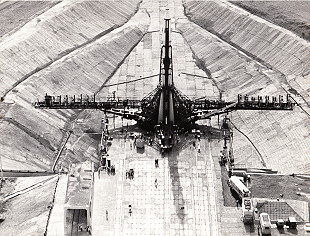
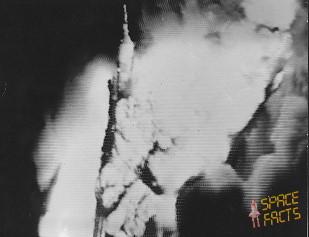
The crew were sitting on the pad awaiting fueling of the
Soyuz-U booster to complete prior to liftoff. At T-90
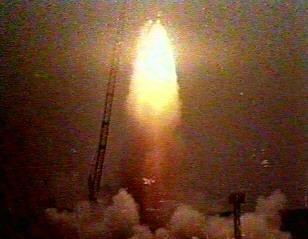
seconds, a valve failed to close, causing liquid kerosene propellant to spill
onto the pad and ignite. The launch control team activated the escape system
but the control cables had already burned, and the
Soyuz crew could not activate or control the escape
system themselves. 20 seconds later, launch control was finally able to
activate the escape system by radio command, by which time the booster was
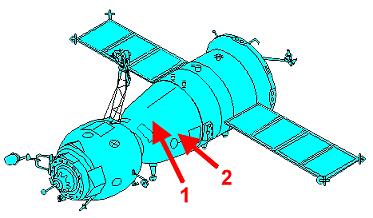
engulfed in flames. Explosive bolts fired to separate the descent module from
the service module and the upper launch shroud from the lower. Then the escape
system motor fired, dragging the orbital module and descent module, encased
within the upper shroud, free of the booster with an acceleration of 14 to 17g
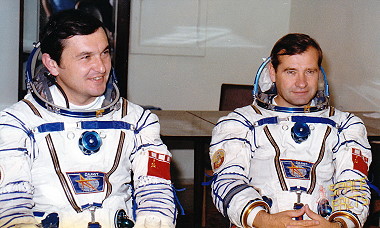
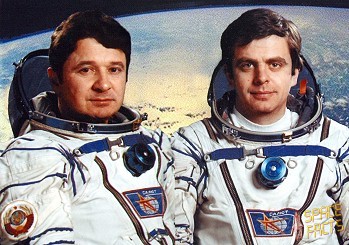
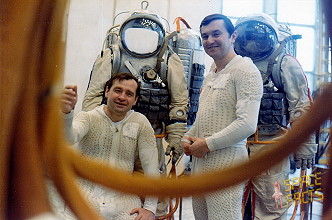
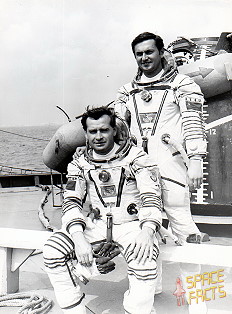
(137 to 167 m/s²) for five seconds. Although Vladimir
Titov and Gennadi
Strekalov had no way of seeing what was going on outside, the
former recalled feeling "unusual vibrations". Just after the escape tower
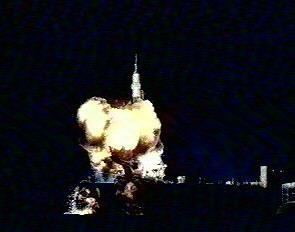
pulled the descent module away, the booster exploded with its remains burning
on the pad for nearly 20 hours. Four paddle-shaped stabilizers on the outside
of the shroud opened and the descent module separated from the orbital module
at an altitude of 650 m, dropping free of the shroud. The descent module
discarded its heat shield, exposing the solid-fuel landing rockets, and
deployed a fast-opening emergency parachute. Landing occurred about four
kilometers from the launch pad. The two crew members were badly bruised after
the high acceleration, but were otherwise okay and did not require any medical
attention.
The explosion and fires severely damaged LC-1 (the same pad
used by Sputnik 1 and
Vostok 1), which
cost an estimated 300 million USD to repair.
Soyuz T-10's descent module was refurbished and later
used on
Soyuz
T-15.