Human Spaceflights

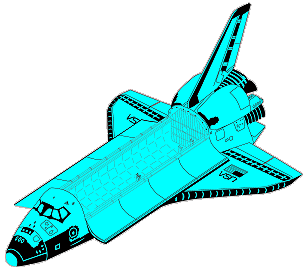
International Flight No. 109STS-61AChallenger (9)22nd Space Shuttle missionUSA |
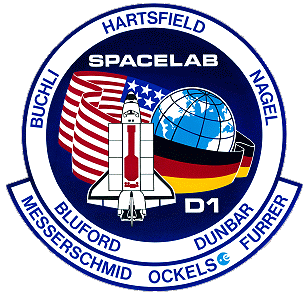 |
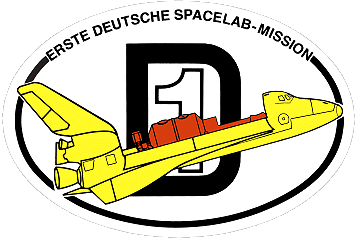 |
Launch, orbit and landing data
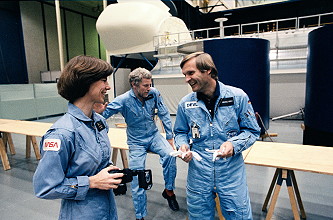
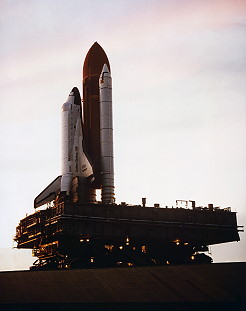
walkout photo |
 |
||||||||||||||||||||||||||||
Crew
| No. | Surname | Given names | Position | Flight No. | Duration | Orbits | |
| 1 |  |
Hartsfield | Henry Warren, Jr. "Hank" | CDR, RMS | 3 | 7d 00h 44m 51s | 112 |
| 2 | |
Nagel | Steven Ray | PLT | 2 | 7d 00h 44m 51s | 112 |
| 3 | |
Dunbar | Bonnie Jeanne | MS-1, EV-2, RMS | 1 | 7d 00h 44m 51s | 112 |
| 4 | |
Buchli | James Frederick | MS-2, EV-1, FE | 2 | 7d 00h 44m 51s | 112 |
| 5 | |
Bluford | Guion Stewart, Jr. "Guy" | MS-3 | 2 | 7d 00h 44m 51s | 112 |
| 6 |  |
Furrer | Reinhard Alfred | PS-1 | 1 | 7d 00h 44m 51s | 112 |
| 7 | |
Messerschmid | Ernst Willi | PS-2 | 1 | 7d 00h 44m 51s | 112 |
| 8 |  |
Ockels | Wubbo Johannes | PS-3 | 1 | 7d 00h 44m 51s | 112 |
Crew seating arrangement
|
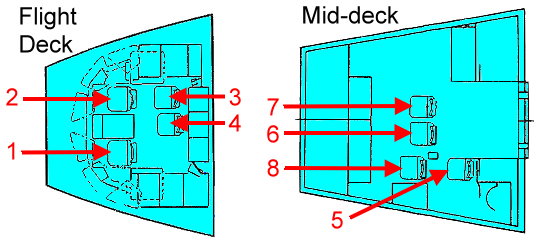 |
|
||||||||||||||||||||||||||||||||||||
Backup Crew
|
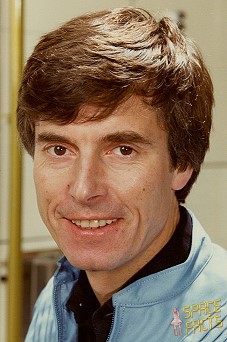 |
||||||||||
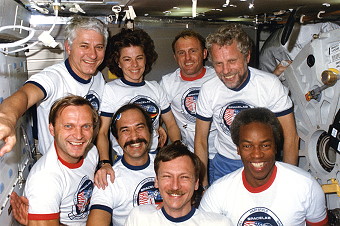
alternative crew photo |
Hardware
| Orbiter : | OV-099 (9.) |
| SSME (1 / 2 / 3): | 2023 (4.) / 2020 (5.) / 2021 (5.) |
| SRB: | BI-022 |
| ET: | ET-24 (LWT-17) |
| OMS Pod: | Left Pod 01 (8.) / Right Pod 03 (7.) |
| FWD RCS Pod: | FRC 9 (9.) |
| RMS: | 302 (4.) |
| EMU: | EMU No. 1074 (PLSS No. 1010) / EMU No. 1073 (PLSS No. 1007) |
Flight
|
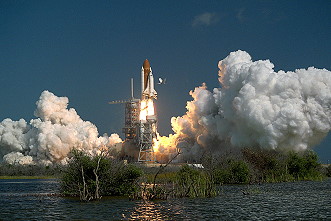
Launch from Cape Canaveral (KSC) and
landing on the Edwards
AFB, Runway
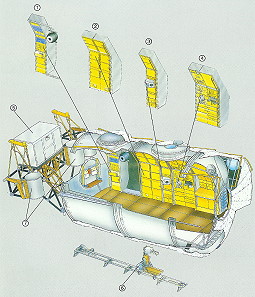
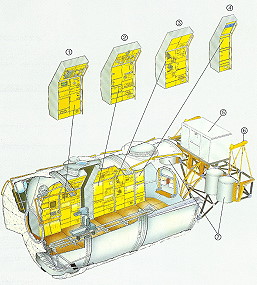
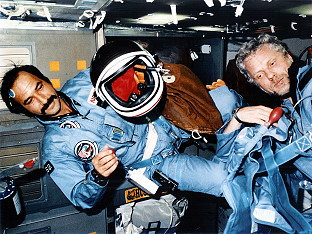
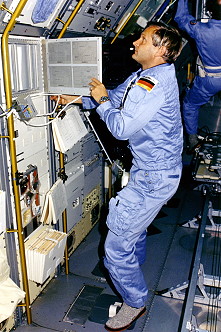
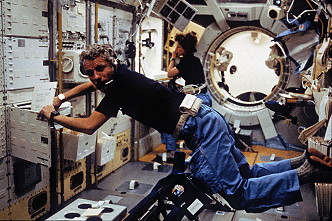
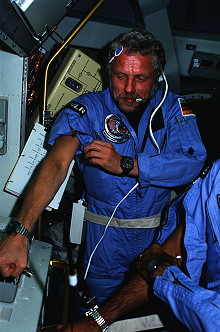
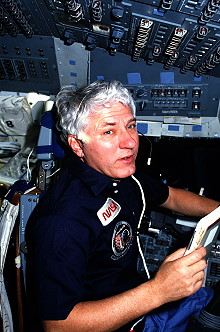
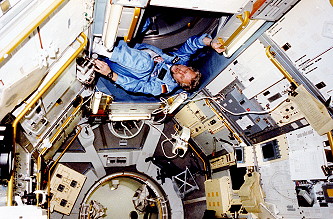
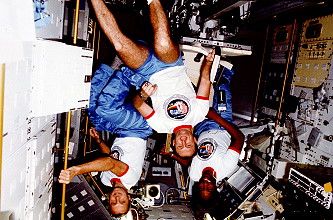
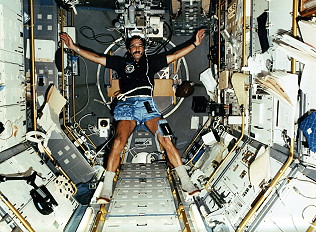
17. This mission was the first spaceflight of two German astronauts at the same time. STS-61A holds the record for the largest crew: eight people, aboard any single spacecraft for the entire period from launch to landing. The primary task of STS-61A was to conduct a series of experiments, almost all related to functions in microgravity, in Spacelab D-1, the fourth flight of a Spacelab orbital laboratory module. Two other mission assignments were to deploy the Global Low Orbiting Message Relay Satellite (GLOMR) out of a Getaway Special canister in the cargo bay, and to operate five materials processing experiments, which were mounted in the orbiter's payload bay on a separate device called the German Unique Support Structure. This was the first Space Shuttle mission ("Deutschland Spacelab Mission D-1") largely financed and operated by another nation, West Germany. 75 scientific experiments in fluid physics, with experiments in capillarity, Marangoni convection, diffusion phenomena, and critical points; solidification experiments; single crystal growth; composites; biological studies, including cell functions, developmental processes, and the ability of plants to perceive gravity; medical experiments, including the gravitational perceptions of humans, and their adaptation processes in space; and speed-time interaction studies of people working in space were performed. The orbiter was controlled from the JSC, the scientific experiments were controlled from the German Space Operations Center in Oberpfaffenhofen near Munich. The orbiting crew was divided into two teams, working in shifts to ensure laboratory work was performed 24 hours a day. Members of the red team were James Buchli, Guion Bluford and Ernst Messerschmid. The blue team consisted of Steven Nagel, Bonnie Dunbar and Reinhard Furrer. Communications were optimal throughout the mission and the ground and orbital crews were able to interact regularly. The overall system of one control center controlling spacecraft operations and a second controlling experiment functions worked smoothly in practice. The majority of the facilities were housed together with the necessary technical infrastructure in standard Spacelab racks within the Spacelab module. Werkstofflabor: The WL was designed to be a multipurpose and multi-use facility for materials science and space processing experiments in microgravity. It housed the following hardware: a mirror heating facility, a cryostat, a gradient heating facility, a fluid physics module, an isothermal heating facility and a high-temperature thermostat. Prozesskammer: The PK (or process chamber) was tailored to the requirements of the scientists. It was designed to show and measure flows, heat and mass transport, and temperature distribution occurring during melting and solidification processes, as well as during phase changes of liquids. Vestibular Sled: The VGS was an ESA contribution consisting of a seat for a test subject that could be moved backward and forward with precisely adjusted accelerations along rails fixed on the floor of Spacelab's aisle. The seat was driven by an electro-motor and traction rope. The sled permitted tests to investigate the functional organization of man's vestibular and orientation system and the vestibular adaptation processes under microgravity. The acceleration of the astronauts was combined with thermal stimulations of the inner ear and optokinetic stimulations of the eye. MEDEA: The Material science Experiment Double rack for Experiment modules and Apparatus (MEDEA) was composed of three largely autonomous experiment facilities. Metallurgical and directional solidification experiments will be performed in a gradient furnace. Crystal growth was carried out in the monoelipsoidal mirror heating facility. The high precision thermostat measured specific heat at the critical point of a specimen. Biowissenschaften (BW): This life sciences payload experiment package combined a group of three-element botanical or biological and two medical experiments in which a small botanical garden were tended during the mission. Frog larvae development were investigated in the "frog statolith" experiment. The third experiment in the field of life sciences continued the first Spacelab's medical experiments of the central venous pressure. For the first time, the internal pressure of the eye was measured. This experiment was designed to study fluid shifts under the effect of microgravity, as well as the adaptive behavior of the related human organs. Biorack (BR): The Biorack was a multipurpose ESA research facility that can repeatedly perform biological experiments under weightlessness. Two incubators with different operating temperatures, a freezer and a hermetically sealed glove box were located in a single rack. To provide for the necessary controlled environment, different types of sample containers are provided, some equipped with measurement points that were controlled by the Spacelab computer system. During the ascent and descent phases, the containers with biological material were stowed and passively temperature controlled in the middeck area to ensure late access to and early retrieval from the orbiter. NAVEX: The navigation experiments payload element had two main objectives: development and testing of a precise clock synchronization; and testing a method for precise one-way distance measurement and position determination. Material Experiment Assembly: The MEA was a self-contained facility that provides accommodation for multidiscipline experiments in the materials processing field. MEA was developed for NASA's OSTA-2, and has flown on several missions. Two other mission assignments were to deploy the Global Low Orbiting Message Relay Satellite (GLOMR) out of a Getaway Special canister in the cargo bay, and to operate five materials processing experiments, which were mounted in the orbiter's payload bay on a separate device called the German Unique Support Structure. The experiments included investigations into fluid physics, with experiments in capillarity, Marangoni convection, diffusion phenomena, and critical points; solidification experiments; single crystal growth; composites; biological studies, including cell functions, developmental processes, and the ability of plants to perceive gravity; medical experiments, including the gravitational perceptions of humans, and their adaptation processes in space; and speed-time interaction studies of people working in space. The Global Low Orbiting Message Relay Satellite (GLOMR) was carried in a standard Getaway Special (GAS) container mounted on the port side of the orbiter payload bay in the vicinity of the Spacelab Tunnel. It was ejected via a standard Autonomous Payload Controller located in the orbiter aft flight deck. Upon receiving the proper command, a Full Diameter Motorized Door Assembly on the GAS canister opened and a spring-loaded device pushed the satellite from the container at a rate of 3-½ feet per second. The GLOMR satellite was a data-relay, communications spacecraft and was expected to remain in orbit for approximately 1 year. The purpose of the 150-pound (68 kg), 62-sid polyhedron satellite was to demonstrate the ability to read signals and command oceanographic sensors, locate oceanographic and other ground sensors, and relay data from them to customers. This was the second attempt to deploy GLOMR. It was carried on mission STS-51B in April 1985 but was not deployed due to problems with the battery supply. One equipment item of unusual interest was the Vestibular Sled, an ESA contribution consisting of a seat for a test subject that could be moved backward and forward with precisely controlled accelerations and stops, along rails fixed to the floor of the Spacelab aisle. By taking detailed measurements on a human strapped into the seat, scientists gained data on the functional organization of the human vestibular and orientation systems, and the vestibular adaptation processes under microgravity. The acceleration experiments by the sled riders were combined with thermal stimulations of the inner ear and optokinetic stimulations of the eye. |
Photos / Graphics
 |
 |
 |
 |
 |
 |
 |
 |
 |
 |
 |
 |
 |
 |
 |
 |
 |
 |
 |
 |
 |
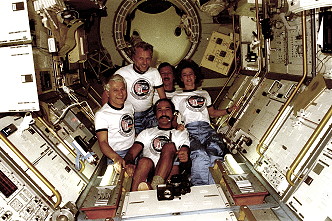 |
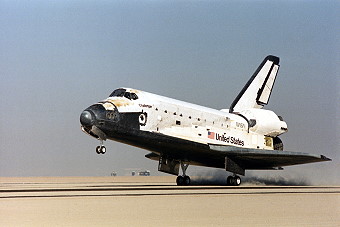 |
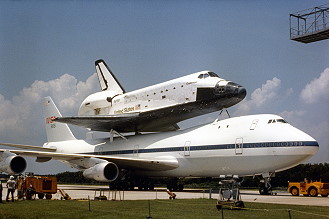 |
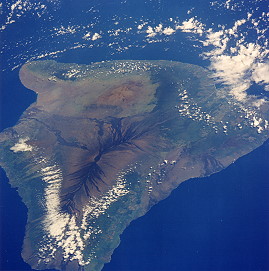
more Earth observation photos |
|
| © |  |
Last update on December 22, 2020.  |
 |