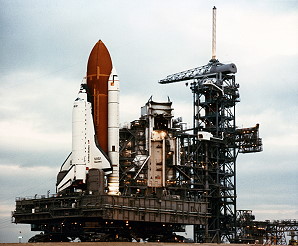
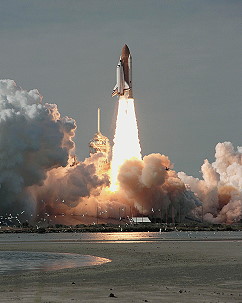
Launch from Cape Canaveral (
KSC) and
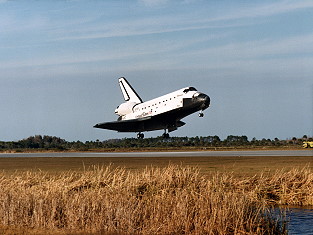
landing at Cape Canaveral (
KSC), Runway 15.
The launch was scheduled for
January 23, 1985 but was delayed because of freezing weather conditions.
Orbiter Challenger had been scheduled for this flight, but Discovery was
substituted when thermal tile problems were encountered with
Challenger.
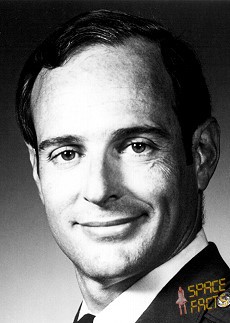
Gary
Payton became the
first military astronaut in space.
This was the
first Shuttle mission dedicated to Department of
Defense, and most information about it remains classified. For the first
time,
NASA did not provide pre-launch commentary to the
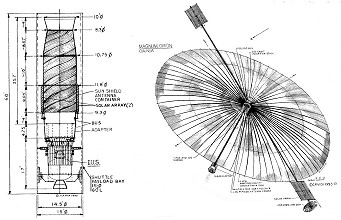
public until nine minutes before liftoff. The U.S. Air Force Inertial Upper
Stage (
IUS/ELINT) booster was deployed and met mission
objectives. It is believed that the payload was a
Magnum/ORION ELINT
satellite into geosynchronous orbit, and that
STS-33 and
STS-38 launched others. Gary
Payton stated in 2009 that
STS-51C's payload is "still up there, and still
operating".
Also, according to Aviation Week, the shuttle initially
entered a 204-kilometer (127 mi) x 519-kilometer (322 mi) orbit, at an
inclination of 28.45 degrees to the equator. It then executed three Orbital
Maneuvering System (
OMS) burns, the last being executed on the fourth
orbit. The first burn was conducted to circularize the shuttle's orbit at 519
kilometers (322 mi).
Almost exactly a year after
STS-51C, Space Shuttle Challenger was destroyed with
all hands on-board during the
STS-51L mission
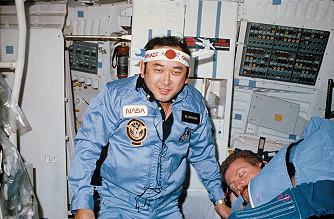
including Ellison
Onizuka, a crew member on both flights. As part of the
investigation into the disaster, it was reported to the Rogers Commission that
during the launch of
STS-51C, the worst solid rocket booster (
SRB) blow-by effects of any mission prior to
STS-51L
occurred, indicating conclusively that the Viton O-rings were not sufficiently
sealing the hot gases inside the combustion chambers of the
SRBs while firing. After they were recovered
post-flight, the O-rings in both the right and left
SRBs showed some degree of charring, but analysis of
the center field joint of the right
SRB showed an unprecedented penetration of the primary
O-ring and heavy charring on the secondary O-ring.