Human Orbital Spaceflights

International Flight No. 87Soyuz T-8OkeanUSSR |
 |
Launch, orbit and landing data
walkout photo |
 |
|||||||||||||||||||
alternative crew photo |
alternative crew photo |
|||||||||||||||||||
original crew photo |
alternative crew photo |
|||||||||||||||||||
alternative crew photo |
||||||||||||||||||||
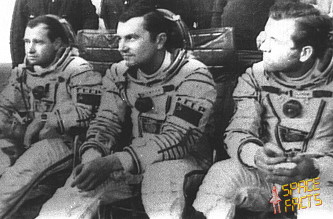
Crew
| No. | Surname | Given names | Position | Flight No. | Duration | Orbits | |
| 1 |  |
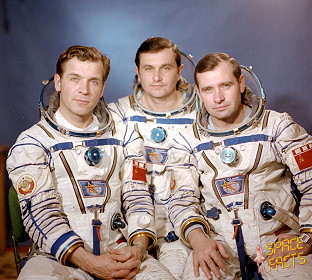
Titov | Vladimir Georgiyevich | Commander | 1 | 2d 00h 17m 48s | 32 |
| 2 | |
Strekalov | Gennadi Mikhailovich | Flight Engineer | 2 | 2d 00h 17m 48s | 32 |
| 3 | |
Serebrov | Aleksandr Aleksandrovich | Research Cosmonaut | 2 | 2d 00h 17m 48s | 32 |
Crew seating arrangement
|
 |
|
||||||||||||||||
Backup Crew
|
 |
||||||||||||||||||||
Hardware
| Launch vehicle: | Soyuz-U (No. Sh15000-342) |
| Spacecraft: | Soyuz T-8 (7K-ST No. 13L) |
Flight
|
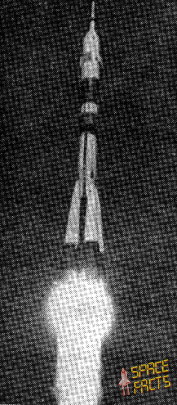
Launch from the Baikonur Cosmodrome and
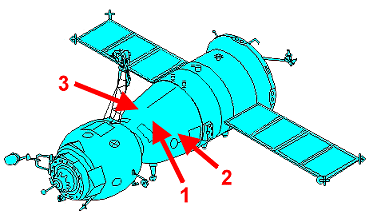
landing 60 km northeast of Arkalyk. The main goal of the mission was to repair the faulty Salyut 7 solar array. Once in orbit the Soyuz rendezvous radar antenna boom failed to deploy properly. Several attitude control maneuvers at high rates were made but failed to swing the boom out. (The postflight inquiry later discovered that the antenna had been torn off when the Soyuz payload shroud separated.) The crew believed the boom remained attached to the spacecraft’s orbital module, and that it had not locked into place. Accordingly, they shook the spacecraft using its attitude thrusters in an effort to rock it forward so it could lock. With FCC permission, the crew attempted a rendezvous using only an optical sight and ground radar inputs for guidance. During the final approach, which was made in darkness, Vladimir Titov believed that the closing speed was too great. He therefore attempted a braking maneuver, but felt that the two spacecraft were still closing too fast. He aborted the rendezvous to avoid a crash, and no further attempts were made. The abortive docking attempts consumed much propellant. To ensure that enough would remain to permit deorbit, the cosmonauts shut down the attitude control system and put Soyuz T-8 into a spin stabilized mode of the type used by Soyuz Ferries in the early 1970s. A premature return to Earth was needed. The Soyuz spacecraft is composed of three elements attached end-to-end - the Orbital Module, the Descent Module and the Instrumentation/Propulsion Module. The crew occupied the central element, the Descent Module. The other two modules are jettisoned prior to re-entry. They burn up in the atmosphere, so only the Descent Module returned to Earth. The deorbit burn lasted about 3 to 4 minutes. Having shed two-thirds of its mass, the Soyuz reached Entry Interface - a point 400,000 feet (121.9 kilometers) above the Earth, where friction due to the thickening atmosphere began to heat its outer surfaces. With only 23 minutes left before it lands on the grassy plains of central Asia, attention in the module turned to slowing its rate of descent. Eight minutes later, the spacecraft was streaking through the sky at a rate of 755 feet (230 meters) per second. Before it touched down, its speed slowed to only 5 feet (1.5 meter) per second, and it lands at an even lower speed than that. Several onboard features ensure that the vehicle and crew land safely and in relative comfort. Four parachutes, deployed 15 minutes before landing, dramatically slowed the vehicle's rate of descent. Two pilot parachutes were the first to be released, and a drogue chute attached to the second one followed immediately after. The drogue, measuring 24 square meters (258 square feet) in area, slowed the rate of descent from 755 feet (230 meters) per second to 262 feet (80 meters) per second. The main parachute was the last to emerge. It is the largest chute, with a surface area of 10,764 square feet (1,000 square meters). Its harnesses shifted the vehicle's attitude to a 30-degree angle relative to the ground, dissipating heat, and then shifted it again to a straight vertical descent prior to landing. The main chute slowed the Soyuz to a descent rate of only 24 feet (7.3 meters) per second, which is still too fast for a comfortable landing. One second before touchdown, two sets of three small engines on the bottom of the vehicle fired, slowing the vehicle to soften the landing. The landing then was without problems. |
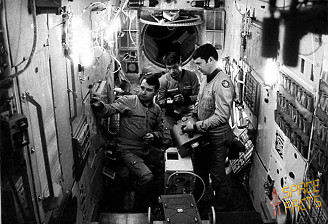
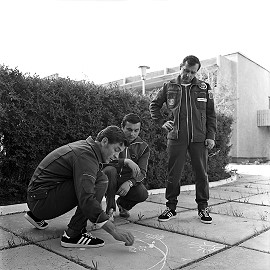
Photos
 |
 |
 |
 |
| © |  |
Last update on February 02, 2023.  |
 |