Human Orbital Spaceflights

International Flight No. 67Soyuz 32Soyuz 34ProtonUSSR |
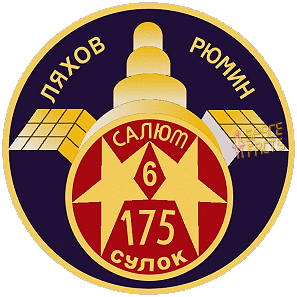 |
Launch, orbit and landing data
walkout photo |
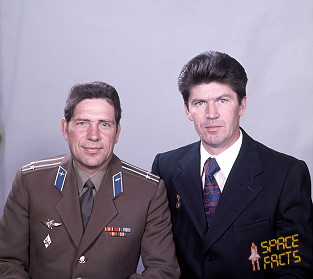 |
|||||||||||||||||||||||||||||||||||||||||||||||||||||
alternative crew photo |
alternative crew photo |
|||||||||||||||||||||||||||||||||||||||||||||||||||||
alternative crew photo |
alternative crew photo |
|||||||||||||||||||||||||||||||||||||||||||||||||||||
alternative crew photo |
alternative crew photo |
|||||||||||||||||||||||||||||||||||||||||||||||||||||
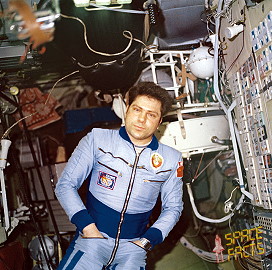
Crew
| No. | Surname | Given names | Position | Flight No. | Duration | Orbits | |
| 1 |  |
Lyakhov | Vladimir Afanasiyevich | Commander | 1 | 175d 00h 35m 37s | 2755 |
| 2 | |
Ryumin | Valeri Viktorovich | Flight Engineer | 2 | 175d 00h 35m 37s | 2755 |
Crew seating arrangement
|
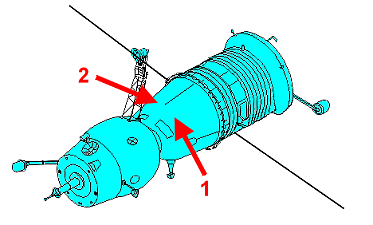 |
|
||||||||||||
Backup Crew
|
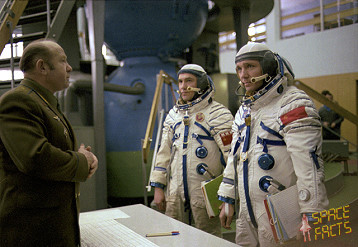 |
Hardware
| Launch vehicle: | Soyuz-U (No. Yo15000-155) |
| Spacecraft: | Soyuz 32 (7K-T No. 48) |
Flight
|
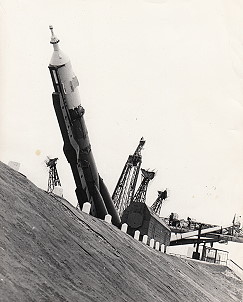
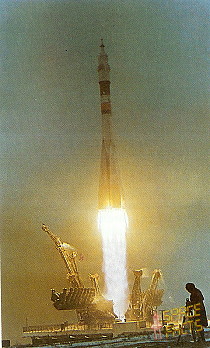
Launch from the Baikonur Cosmodrome and
landing of the unmanned
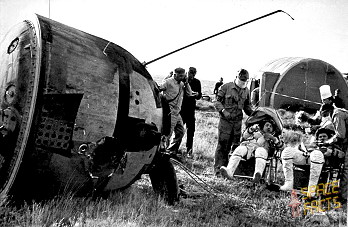
Soyuz 32 capsule 295 km northwest of Dzheskasgan. The
crew landed with Soyuz 34 186 km
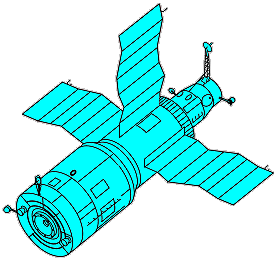
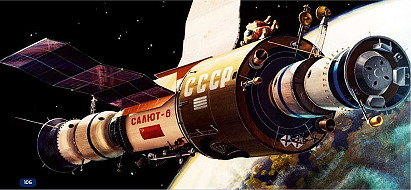
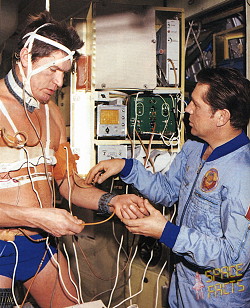
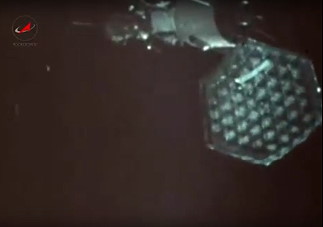
southeast of Dzheskasgan. Following a one-day solo flight Soyuz 32 docked with Salyut 6 on February 26, 1979. The cosmonauts became the third resident crew. When they arrived on the station, they had to make preparing work, because the station had to be repaired (sprung propellant leak of the propulsion system). Progress 5, an unmanned supply tanker, was launched March 12, 1979 and docked with the station two days later. The crew spent four days unloading the vehicle. Supplies delivered included parts for station repair, an extra storage battery, a television monitor, a new Kristall furnace to replace the old one which had broken, a gamma ray telescope and food. A total of 300 items weighing 1,300 kg were delivered. The tanker also delivered 1,000 kg of propellant for the station. The tank repairing took some time, after the arrival of the Progress 5 spacecraft, but was successful. The Soviets revealed the propulsion problem on March 16, 1979. They said a Salyut fuel tank was leaking fuel into the nitrogen bellows which pressurized the fuel. The station's engine systems were not affected, but valves and regulators in the pressurization system were at potential risk. Accordingly, the crew shut down the tank and used a reserve tank. The crew attempted to drain the leaking tank by rotating the station and succeeded by March 23, 1979, purged the tank with nitrogen and closed it off. A milestone was reached March 24, 1979 when the cosmonauts installed a television monitor which allowed a two-way television link with ground control. For the first time, cosmonauts received television pictures in space. Seeing family, instead of just hearing them, was considered to have great psychological importance, especially as longer flights were contemplated. On March 30, 1979, Progress 5 boosted the station's orbit, then Soyuz 32 boosted the orbit again on April 06, 1979 in preparation for the upcoming Soyuz 33 crew. Progress 5 was undocked April 03, 1979 and deorbited two days later. Soyuz 33 was launched April 10, 1979 with the fourth international crew in the Soviet Intercosmos program. Bulgarian cosmonaut Georgi Ivanov joined Commander Nikolai Rukavishnikov as the craft proceeded normally towards the space station. But, as the craft approached to 1,000 meters, the engine failed and shut down after three seconds of a planned six-second burn. Nikolai Rukavishnikov had to hold the instrument panel as the craft violently shook. A second firing attempt was made, but the engine shut down again, and Valeri Ryumin, observing from the station, reported an abnormal lateral glow from behind the Soyuz during the burn. Mission control accordingly aborted the mission and told the crew to prepare to return to earth. It was the first in-orbit failure of the Soyuz propulsion system. It was only in 1983 that the Soviets revealed how serious the situation was. The craft had a back-up engine but it was feared that it may have been damaged by the main engine, potentially leaving the crew stranded with five days of supplies while it would take ten days for the orbit to decay. The station could have been moved to within 1,000 m of the craft, but the two craft were drifting apart at 28 meters per second, and time was needed to calculate the maneuvers. In any event, the crew on the station with one malfunctioning Soyuz and a second Soyuz (Soyuz 32) with a now-questionable engine (it had the same type as Soyuz 33) was not considered the best option. In the end, the backup engine did fire, though for 25 seconds too long, resulting in an unusually steep trajectory and loads of 10 G's to be endured by the crew. Nikolai Rukavishnikov and Georgi Ivanov were safely recovered. After the Soyuz 33 failure, the station crew was stuck with a suspect craft. The Soyuz 33 craft was intended to be swapped for the Soyuz 32, but the failure called into question the reliability of Soyuz 32's main engine. Until the design was corrected and a new vehicle launched, the crew was safe on Salyut with the Soyuz usable in an emergency. The fifth international flight, scheduled for June 05, 1979, was postponed. Vladimir Lyakhov and Valeri Ryumin continued their station activities, including experiments intended to be carried out with the visiting crew (which had been delivered aboard the Progress 5 flight), such as one called Pirin which investigated the formation of metal whiskers on zinc crystals, and another which made multi-spectral measurements of the daylight atmosphere. They were given five days off for the May Day holiday. Progress 6 was launched May 13, 1979 and delivered some 100 items. The Soyuz 33 engine failure did not affect the supply tanker as it differed in its design. Unloading took two days, a new navigational unit was installed, and the tanker raised the station's orbit on May 22, 1979. Refueling was completed by May 28, 1979, more orbital adjustments were made June 04, 1979 and June 05, 1979, and Progress 6 was undocked June 08, 1979. After unloading, Progress 6 circularized Salyut 6's orbit on May 29, 1979 in preparation for the arrival of Soyuz 34. It undocked on June 08, 1979, clearing the port for the arrival of Soyuz 34, which ensured that Valeri Ryumin and Vladimir Lyakhov would be able to complete their mission. The Soyuz 34 was needed, because of the failing docking attempt of the Soyuz 33 spacecraft. Soyuz spacecrafts could only be used for 90 days at this time. Soyuz 34 also tested improvements to the Soyuz main engine meant to prevent recurrence of the Soyuz 33 failure. The spacecraft delivered 200 kg of cargo. Soyuz 32 returned to Earth unmanned with a cargo of experiment results and malfunctioning Salyut 6 equipment. The equipment was of interest to space station engineers. Testing of the new developed Gamma-Ray-Telescope was one of the main objectives. Experiments in materials science were also performed. On June 14, 1979 the Soviets transferred Soyuz 34 from the aft port to the front port by rotating Salyut 6. This freed the aft port for the next unmanned freighter. Progress 7 was launched June 28, 1979 and docked at Salyut 6 two days later. It carried 1,230 kg of supplies including food, plants, mail and a 10-meter diameter radio telescope. The telescope unfolded independent at the stations tall. The crew tested the "Kosmic Radio-Telescope" (KRT-10). Valeri Ryumin and Vladimir Lyakhov had not seen the complete system before because the KRT-10 was still being tested and manufactured at the time they were trained to assemble it. Control panels were attached to the conical housing in the large-diameter compartment and data recorders to the station's 'ceiling.' A 'cable entrance mechanism' was assembled in the intermediate compartment, behind the device for securing the antenna to the station, which filled the aft port. The diameter of the folded antenna was only 0.5 m. As Progress 7 backed away from the station, Valeri Ryumin commanded the antenna to unfold from the aft port. A TV camera on Progress 7 transmitted a blurry image of Salyut 6's aft port to the TsUP and the TV aboard Salyut 6 as the KRT-10 opened to its full 10-m diameter. On August 09, 1979 the KRT-10 antenna failed to separate from Salyut 6. Examination through the aft-facing ports indicated that the antenna was snared on the aft docking target. This prevented further Progress dockings and interfered with the engines. The third resident crew attempted to free the antenna by rocking the station. After considering abandoning Salyut 6 - according to Valeri Ryumin, its primary mission was complete - crew and TsUP agreed to attempt an EVA to remove the antenna. Vladimir Lyakhov and Valeri Ryumin conducted an EVA on August 15, 1979 (1h 23m). On day 172 of Vladimir Lyakhov and Valeri Ryumin transferred their experiment results, film, specimen cassettes, and personal items to the Soyuz 34 spacecraft, in case they were unable get back inside the Salyut 6 work compartment after this contingency EVA to remove the KRT-10 antenna from Salyut 6's aft docking port. During EVA preparations the backup fan in Valeri Ryumin's suit failed because its control unit was exposed to high humidity. Insulation on the control unit was subsequently improved in later suits. Soviet surgeons reported later that Valeri Ryumin and Vladimir Lyakhov maintained a heart rate very similar to their preflight rate (about 60 beats/minutes) throughout the flight, but that this changed during the EVA. Valeri Ryumin's heart rate reached 130 beats/minutes while he waited in the airlock. He clambered out the EVA hatch first, about 10 minutes before Salyut 6 slipped into night. By this time the cosmonauts were out of range of ground stations. Three hours were allotted for the EVA, and communication was expected to be restored halfway through. With difficulty, Valeri Ryumin opened a handrail recessed into the station's hull, then gripped it with one hand for 30 min until orbital sunrise. Vladimir Lyakhov remained inside the depressurized transfer compartment. As Valeri Ryumin moved aft along the station, Vladimir Lyakhov took his place at the handrail and paid out the umbilical connected to Valeri Ryumin's Orlan-D suit. Valeri Ryumin had to use a "nipper" (wirecutters designed for IV use) to cut through four 1-mm steel cables and free the antenna, which flops loosely at the rear of the station. Each time he cut at a cable, the 10-m-diameter (33-ft-diameter) antenna pitched toward him, threatening to cut his suit (as it had cut thermal insulation blankets on the station's aft bulkhead) or smash him. Vladimir Lyakhov positioned himself so he could warn Valeri Ryumin of the dish's movements. Valeri Ryumin's heart rate reached 146 beats/minutes while he worked. Finally, the last cable was cut and Valeri Ryumin pushed the KRT-10 antenna away with a "forked stick." When communication was restored with the ground the cosmonauts reported that they had completed their task, and at first were not believed. While flight controllers and official spectators in the TsUP applauded their triumph, Valeri Ryumin and Vladimir Lyakhov returned to the exterior of the transfer compartment, where Valeri Ryumin wiped a porthole with a cloth to collect samples of obscuring "space dust." The cosmonauts also collected space exposure experiment cassettes mounted just outside the EVA hatch. After the EVA Valeri Ryumin found a small puncture in his suit's primary bladder, possibly caused by a sharp wire on the KRT-10 antenna. The Soyuz spacecraft is composed of three elements attached end-to-end - the Orbital Module, the Descent Module and the Instrumentation/Propulsion Module. The crew occupied the central element, the Descent Module. The other two modules are jettisoned prior to re-entry. They burn up in the atmosphere, so only the Descent Module returned to Earth. The deorbit burn lasted 188 seconds. Having shed two-thirds of its mass, the Soyuz reached Entry Interface - a point 400,000 feet (121.9 kilometers) above the Earth, where friction due to the thickening atmosphere began to heat its outer surfaces. With only 23 minutes left before it lands on the grassy plains of central Asia, attention in the module turned to slowing its rate of descent. Eight minutes later, the spacecraft was streaking through the sky at a rate of 755 feet (230 meters) per second. Before it touched down, its speed slowed to only 5 feet (1.5 meter) per second, and it lands at an even lower speed than that. Several onboard features ensure that the vehicle and crew land safely and in relative comfort. Four parachutes, deployed 15 minutes before landing, dramatically slowed the vehicle's rate of descent. Two pilot parachutes were the first to be released, and a drogue chute attached to the second one followed immediately after. The drogue, measuring 24 square meters (258 square feet) in area, slowed the rate of descent from 755 feet (230 meters) per second to 262 feet (80 meters) per second. The main parachute was the last to emerge. It is the largest chute, with a surface area of 10,764 square feet (1,000 square meters). Its harnesses shifted the vehicle's attitude to a 30-degree angle relative to the ground, dissipating heat, and then shifted it again to a straight vertical descent prior to landing. The main chute slowed the Soyuz to a descent rate of only 24 feet (7.3 meters) per second, which is still too fast for a comfortable landing. One second before touchdown, two sets of three small engines on the bottom of the vehicle fired, slowing the vehicle to soften the landing. At the end of the mission the crew set a new spaceflight record. Because the cosmonauts were so weakened from six months in zero gravity (a bouquet of flowers presented to them reportedly felt like "a ton of bricks"), a system of slides and chutes had to be deployed for them to exit the Soyuz descent module. |
EVA data
| Name | Start | End | Duration | Mission | Airlock | Suit | Stripes | |
| EVA | Ryumin, Valeri | 15.08.1979, 14:16 UTC | 15.08.1979, 15:39 UTC | 1h 23m | Soyuz 32 | Salyut 6 | Orlan-D No. 34 | blue |
| EVA | Lyakhov, Vladimir | 15.08.1979, 14:16 UTC | 15.08.1979, 15:39 UTC | 1h 23m | Soyuz 32 | Salyut 6 | Orlan-D No. 33 | red |
Photos / Graphics
 |
 |
|
source of all photos is Roscosmos / TASS |
|
 |
 |
 |
 |
 |
 |
 |
 |
 |
 |
 |
| © |  |
Last update on January 27, 2023.  |
 |