Human Orbital Spaceflights

International Flight No. 57Soyuz 22YastrebUSSR |
Launch, orbit and landing data
|
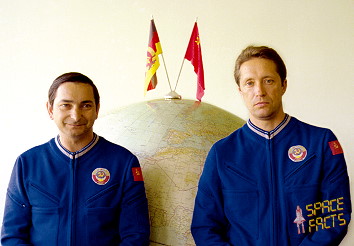 |
|||||||||||||||||||
alternative crew photo |
alternative crew photo |
|||||||||||||||||||
alternative crew photo |
alternative crew photo |
|||||||||||||||||||
alternative crew photo |
||||||||||||||||||||
Crew
| No. | Surname | Given names | Position | Flight No. | Duration | Orbits | |
| 1 |  |
Bykovsky | Valeri Fyodorovich | Commander | 2 | 7d 21h 52m 17s | 127 |
| 2 | |
Aksyonov | Vladimir Viktorovich | Flight Engineer | 1 | 7d 21h 52m 17s | 127 |
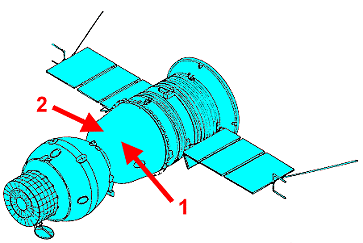
Crew seating arrangement
|
 |
|
||||||||||||
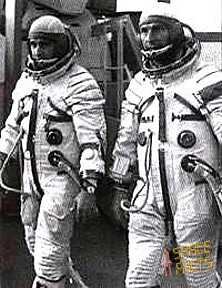
1st Backup Crew
|
 |
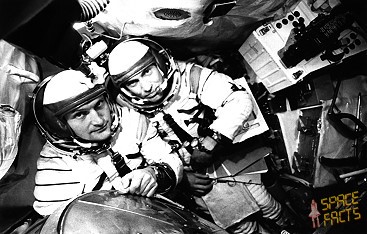
2nd Backup Crew
|
 |
Hardware
| Launch vehicle: | Soyuz-U (No. E15000-69) |
| Spacecraft: | Soyuz 22 (7K-TM No. 74) |
Flight
|
Launch from the Baikonur Cosmodrome and
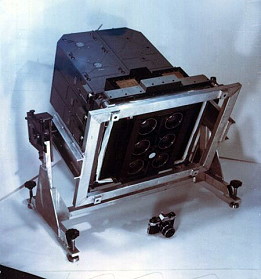
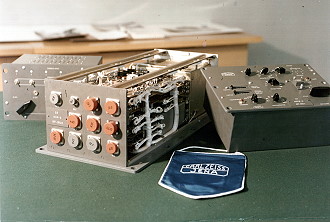
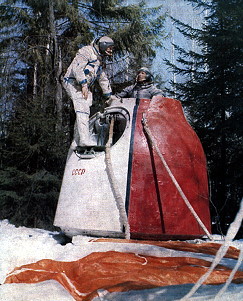
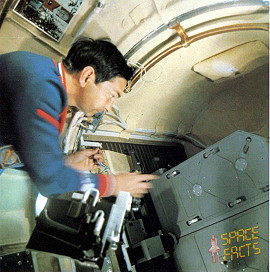
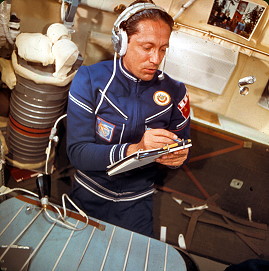
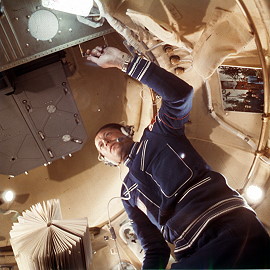
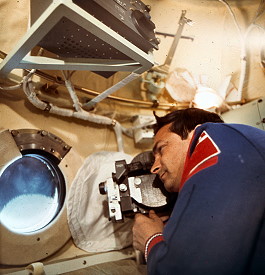
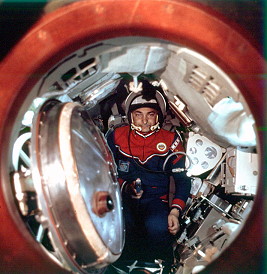
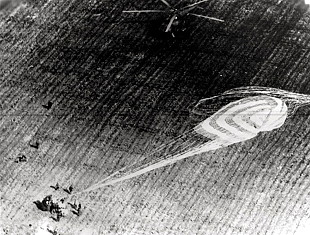
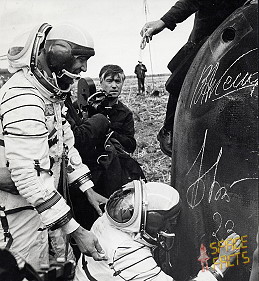
landing 150 km northwest of Tselinograd. Soyuz 22 was launched to orbit September 15, 1976 at the unusually high inclination of 64.75°, not used since the Voskhod program. The orbiting Salyut 5 space station was at the standard 51.8° inclination, which led some observers to conclude that this solo Soyuz mission was chiefly intended to observe NATO's Exercise Teamwork, taking place in Norway, well above 51° latitude and therefore outside of good visual range of the space station. However, the particular camera used, an MKF-6 multi-spectral Carl Zeiss camera which allowed six simultaneous photographs to be taken, suggested to others that reconnaissance, if part of the mission, was a minor part of it. Soyuz 22's orbital inclination maximized ground coverage, especially of the former East Germany. There were two orbit changes within 24 hours of launch. The first came on the fourth orbit and changed the orbit to 280 by 250 kilometers (170 by 160 mi). The second, on the sixteenth orbit, circularized the orbit to 257 by 251 kilometers (160 by 156 mi). The mission's stated objectives were to "check and improve scientific and technical methods and means of studying geological features of the Earth's surface in the interests of the national economies of the Soviet Union and the German Democratic Republic." The vehicle was the modified ASTP back-up ship. The ASTP docking mechanism was replaced with an GDR built Carl Zeiss-Jena multi-spectral camera. One cosmonaut would control the operations of the camera from inside the Orbital Module while the second changed the orientation from the Descent Module. The camera had six lenses, four visible light and two infrareds, which imaged a preselected 165 km (103 mi) -wide strip of the Earth's surface. This allowed over 500,000 km² (190,000 square miles) to be imaged in 10 minutes. The first test images from the camera were of Baikal-Amur railway that was being constructed. On the third day of the mission the crew took photographs of Siberia to the Sea of Okhotsk in the morning and the northwestern USSR. On the fourth day, the crew imaged the Moon rising and setting to investigate the Earth's atmosphere. This also allowed them to see how clean their spacecraft's windows were. They also imaged Central Asia, Kazakhstan, and Siberia, with attention to geological formations and agricultural effects. The fifth day focused on Azerbaijan, the southern Urals, the Baikal-Amur railway again, and western Siberia. At the same time a second camera was being flown on an aircraft over the same areas in order to compare the images. The sixth day saw images of Siberia, the Northern USSR, and European USSR which were, according to TASS, areas that had never before been "targets of space photography." The last full day had the crew focus on East Germany, where an An-30 aircraft was flying carrying an identical camera to the one aboard Soyuz 22. They also re-photographed Central Asia, Kazhakstan, eastern Siberia, and the southwestern USSR in order to compare images with those taken earlier in the mission. One of the tasks the crew undertook was to dismantle the camera in order to remove its color filters needed to calibrate the images back on Earth. The task took them several hours to complete. The crew had photographed 30 geographic areas in 2,400 photographs. None of the cassettes were found to be faulty and all the images were of good quality. The results, it was said, would aid experts in the fields of agriculture, cartography, mineralogy, and hydrology. The crew also performed several biological experiments. They ran a small centrifuge in the orbital module to see how plants grew in artificial gravity. They also investigated the effects of cosmic rays on human vision. This effect had first been reported by Apollo astronauts who described bright flashes when they closed their eyes. This was due to cosmic rays passing through the eye. Soyuz 22 also carried a small aquarium so that the crew could watch the behavior of fish. The Soyuz spacecraft is composed of three elements attached end-to-end - the Orbital Module, the Descent Module and the Instrumentation/Propulsion Module. The crew occupied the central element, the Descent Module. The other two modules are jettisoned prior to re-entry. They burn up in the atmosphere, so only the Descent Module returned to Earth. The deorbit burn lasted 188 seconds. Having shed two-thirds of its mass, the Soyuz reached Entry Interface - a point 400,000 feet (121.9 kilometers) above the Earth, where friction due to the thickening atmosphere began to heat its outer surfaces. With only 23 minutes left before it lands on the grassy plains of central Asia, attention in the module turned to slowing its rate of descent. Eight minutes later, the spacecraft was streaking through the sky at a rate of 755 feet (230 meters) per second. Before it touched down, its speed slowed to only 5 feet (1.5 meter) per second, and it lands at an even lower speed than that. Several onboard features ensure that the vehicle and crew land safely and in relative comfort. Four parachutes, deployed 15 minutes before landing, dramatically slowed the vehicle's rate of descent. Two pilot parachutes were the first to be released, and a drogue chute attached to the second one followed immediately after. The drogue, measuring 24 square meters (258 square feet) in area, slowed the rate of descent from 755 feet (230 meters) per second to 262 feet (80 meters) per second. The main parachute was the last to emerge. It is the largest chute, with a surface area of 10,764 square feet (1,000 square meters). Its harnesses shifted the vehicle's attitude to a 30-degree angle relative to the ground, dissipating heat, and then shifted it again to a straight vertical descent prior to landing. The main chute slowed the Soyuz to a descent rate of only 24 feet (7.3 meters) per second, which is still too fast for a comfortable landing. One second before touchdown, two sets of three small engines on the bottom of the vehicle fired, slowing the vehicle to soften the landing. |
Photos
 |
 |
 |
 |
 |
 |
 |
 |
 |
 |
| © |  |
Last update on March 27, 2025.  |
 |