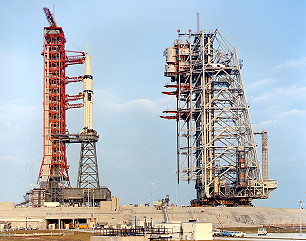
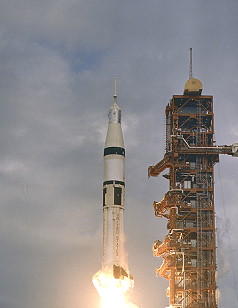
Launch from Cape Canaveral (
KSC) and
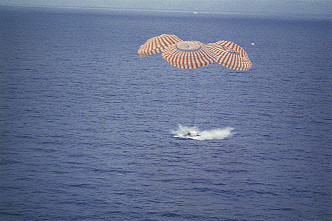
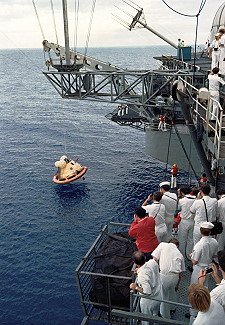
landing 1320 km southwest of San Diego in the Pacific Ocean.
The
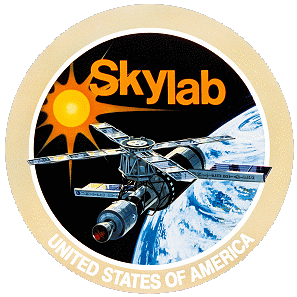
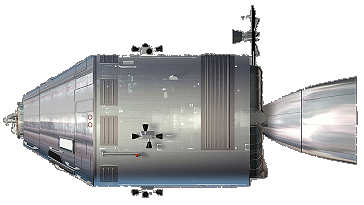
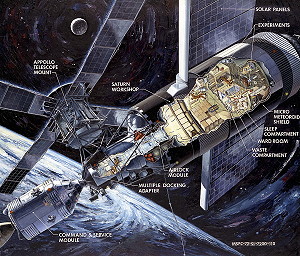
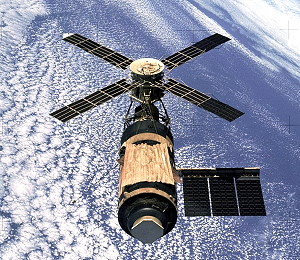
Skylab (SL) was a manned, orbiting spacecraft
composed of five parts, the
Apollo telescope mount (
ATM), the multiple docking adapter (MDA), the airlock
module (AM), the instrument unit (IU), and the orbital workshop (OWS). The
Skylab was in the form of a cylinder, with the
ATM being positioned 90 deg from the longitudinal axis
after insertion into orbit. The
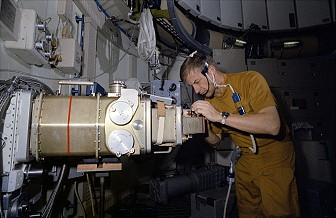
ATM was a solar observatory, and it provided attitude
control and experiment pointing for the rest of the cluster. It was attached to
the MDA and AM at one end of the OWS. The retrieval and installation of film
used in the
ATM was accomplished by astronauts during
extravehicular activity (
EVA). The MDA served as a dock for the command and
service modules, which served as personnel taxis to the Skylab. The AM provided
an airlock between the MDA and the OWS, and contained controls and
instrumentation. The IU, which was used only during launch and the initial
phases of operation, provided guidance and sequencing functions for the initial
deployment of the
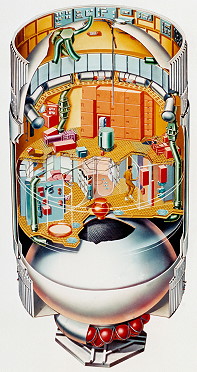
ATM, solar arrays, etc. The OWS was a modified Saturn
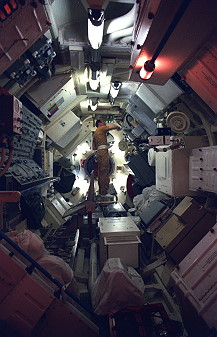
4B stage suitable for long duration manned habitation in orbit. It contained
provisions and crew quarters necessary to support three-person crews for
periods of up to 84 days each. All parts were also capable of unmanned,
in-orbit storage, reactivation, and reuse. The Skylab itself was launched on
May 14, 1973.
The
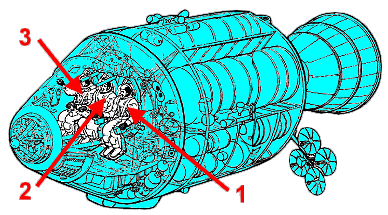
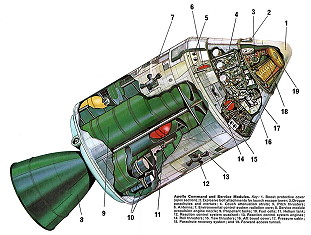
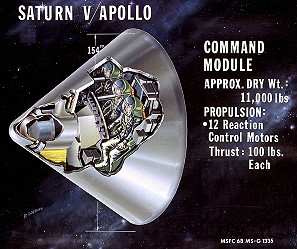
Command Module (CM) was a conical pressure
vessel with a maximum diameter of 3.9 m at its base and a height of 3.65 m. It
was made of an aluminum honeycomb sandwich bonded between sheet aluminum alloy.
The base of the CM consisted of a heat shield made of brazed stainless steel
honeycomb filled with a phenolic epoxy resin as an ablative material and varied
in thickness from 1.8 to 6.9 cm. At the tip of the cone was a hatch and docking
assembly designed to mate with the lunar module. The CM was divided into three
compartments. The forward compartment in the nose of the cone held the three
25.4 m diameter main parachutes, two 5 m drogue parachutes, and pilot mortar
chutes for Earth landing. The aft compartment was situated around the base of
the CM and contained propellant tanks, reaction control engines, wiring, and
plumbing. The crew compartment comprised most of the volume of the CM,
approximately 6.17 cubic meters of space. Three astronaut couches were lined up
facing forward in the center of the compartment. A large access hatch was
situated above the center couch. A short access tunnel led to the docking hatch
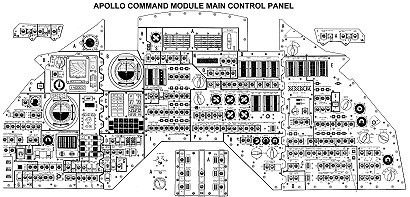
in the CM nose. The crew compartment held the controls, displays, navigation
equipment and other systems used by the astronauts. The CM had five windows:
one in the access hatch, one next to each astronaut in the two outer seats, and
two forward-facing rendezvous windows. Five silver/zinc-oxide batteries
provided power after the CM and SM detached, three for re-entry and after
landing and two for vehicle separation and parachute deployment. The CM had
twelve 420 N nitrogen tetroxide/hydrazine reaction control thrusters. The CM
provided the re-entry capability at the end of the mission after separation
from the Service Module.
The
Service Module (SM) was a cylinder 3.9
meters in diameter and 7.6 m long which was attached to the back of the CM. The
outer skin of the SM was formed of 2.5 cm thick aluminum honeycomb panels. The
interior was divided by milled aluminum radial beams into six sections around a
central cylinder. At the back of the SM mounted in the central cylinder was a
gimbal mounted re-startable hypergolic liquid propellant 91,000 N engine and
cone shaped engine nozzle. Attitude control was provided by four identical
banks of four 450 N reaction control thrusters each spaced 90 degrees apart
around the forward part of the SM. The six sections of the SM held three
31-cell hydrogen oxygen fuel cells which provided 28 volts, two cryogenic
oxygen and two cryogenic hydrogen tanks, four tanks for the main propulsion
engine, two for fuel and two for oxidizer, and the subsystems the main
propulsion unit. Two helium tanks were mounted in the central cylinder.
Electrical power system radiators were at the top of the cylinder and
environmental control radiator panels spaced around the bottom.
This
spacecraft was almost identical to the command and service module used for
Apollo missions. Modification was made to accomodate
long-duration
Skylab missions and to allow the spacecraft to remain
semi-dormant while docked to the
Skylab cluster. A crew of three men and their
provisions were carried. The mission of this spacecraft was to ferry a crew of
three to the
Skylab complex and return them to Earth.
This
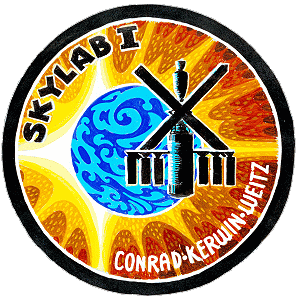
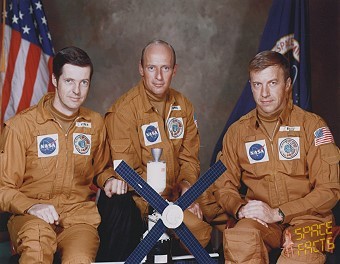
mission carried out the
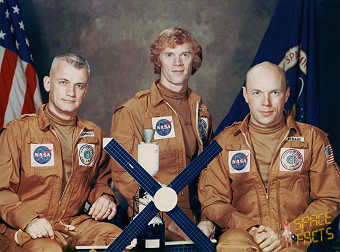
first crew of the
Skylab space station. The flight became a "rescue
mission" for the overheated space station, which had been damaged at its
launch. Launched on May 25, 1973, the first
Skylab crew's most urgent job was to repair the space
station.
Skylab's meteorite-and-sun shield and one of its solar
arrays had torn loose during launch, and the remaining primary solar array was
jammed. Without its shield,
Skylab baked in the sunshine. The crew had to work
fast, because high temperatures inside the workshop would release toxic
materials and ruin on-board film and food
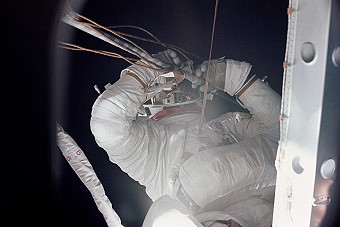
The
first
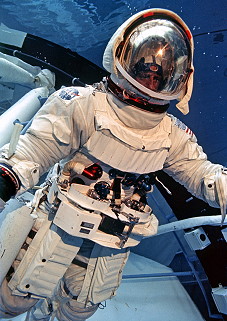
EVA,
in fact a SEVA, was performed by Paul
Weitz
on May 26, 1973 (0h 40m). The astronauts moved the Skylab 2 CM close to the
jammed array. Paul
Weitz
then stood with his upper body through the hatch and assembled a 4.5-m (15-ft)
pole with a shepherd's hook on the end from three 1.5-m (5-ft) sections handed
to him by Joseph
Kerwin. He hooked and pulled on the array while Joseph
Kerwin gripped his legs. Charles
Conrad had to hold the CM steady because Paul
Weitz's efforts pulled it toward the workshop. Paul
Weitz
replaced the hook with a universal prying tool when the strap did not budge,
but to no avail. Their efforts thwarted, the astronauts docked with
Skylab and closed out a 22-hour day.
On June
07, 1973 the
second spacewalk occurred (3h 25m). Joseph
Kerwin and Charles
Conrad rehearsed the planned
EVA
inside
Skylab, and on this date depressurized the
Skylab Airlock Module, which was made cramped by their
burden of tools. Charles
Conrad left the airlock through its surplus
Gemini hatch and stepped into the Pressure Garment
Assembly foot restraint at the Fixed Airlock Shroud work station. Joseph
Kerwin passed him six 1.5-m (5-ft) poles, helped him assemble
the cable cutter assembly, then moved to the discone antenna using the
ATM girders and other projections in the
EVA
Bay as mobility aids. Charles
Conrad handed him the cable cutter assembly, then moved to
the discone antenna carrying the BET. The plan called for Joseph
Kerwin to hook the cable cutter assembly on the strap holding
wing 1 closed. Charles
Conrad would then crawl down the assembly to wing 1 and
attach the BET. However, Joseph
Kerwin had difficulties finding a firm foothold near the
discone because
Skylab unexpectedly differed from the mockup in the
tank in Huntsville. He was forced to hold on with one hand while attempting to
position the pole with the other. After a frustrating half hour, Joseph
Kerwin shortened his 1.8-m (6-ft) tether by doubling it. This
held him more firmly against
Skylab and allowed him partial use of his other hand.
He finally succeeded in hooking the aluminum strap. Charles
Conrad attached the BET large hook to the discone antenna,
then climbed along the cable cutter assembly pole. He attached one of the two
BET small hooks to bolt holes on wing 1. Again, the flight
Skylab differed from the ground mockup; the second
small hook would not fit. Joseph
Kerwin tightened the BET at the discone end using a cleat,
then cut the strap holding the array closed. Charles
Conrad placed the BET over his shoulder, put his feet against
the workshop's hull, and strained against the BET to pull open the array.
Joseph
Kerwin joined him. Finally, the hydraulic damper holding the
array closed gave way.
For the
final
EVA Charles
Conrad and Paul
Weitz
left the
Skylab station on June 19, 1973 (1h 36m). The first
part of the
EVA
was very similar to the
EVA
as planned pre-flight. The astronauts removed film from the
ATM solar telescopes for return to Earth and replaced
the film. This required a fraction of the time planned. Four of
Skylab's five
EVA
work stations were positioned to restrain the astronaut during film changeout.
The Fixed Airlock Shroud (FAS) station, the main
EVA
work station, was located next to the external airlock hatch. The FAS station
was the "base camp" for ascending the ATM. The astronauts moved between the
work stations via the Deployment Assembly route, or "
EVA
Trail." The route consisted of single and dual handrails, the latter resembling
ladders without rungs. According to the
Skylab astronauts, the single handrails worked well,
while translation using the dual rails was as easy as "driving on the freeway."
All handrails were painted blue for visibility and provided with "road signs" -
alphanumeric designators. The blue faded rapidly in the strong sunlight of
space, however, and the designator labels proved difficult to see.
ATM film cassettes were moved in a device called a
film tree. The primary method of moving the trees was by three extendible booms
located in the
EVA
Bay within reach of FAS. Controls for the motorized booms were located next to
the
EVA hatch. The booms could be manually operated if
necessary, and "clotheslines," pulley-type devices, provided a backup film
transport method. Their film changeout tasks completed, Charles
Conrad and Paul
Weitz
removed space exposure samples launched on the workshop's exterior to accompany
them back to Earth. Paul
Weitz
and Charles
Conrad then moved on to tasks added after the successful wing
1 deployment on
EVA
2. They used a brush to clean the White Light Coronograph occulting disk, which
was producing glare. Charles
Conrad then moved to Circuit Breaker Relay Module 15. Acting
on instructions from the ground, he hit it with a hammer to free a stuck relay.
This low-tech solution succeeded and soon the module was feeding electricity
into the
Skylab power system again. The
EVA
brought the total for Skylab 2 to more than 5 hours, twice what was originally
planned.
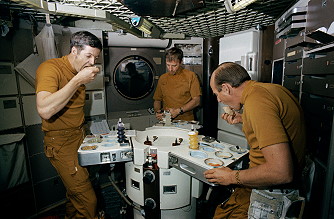
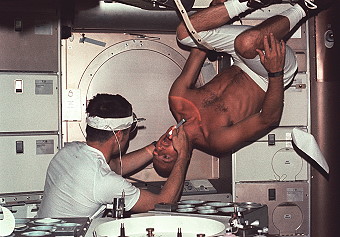
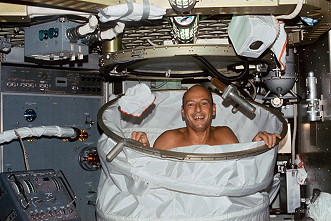
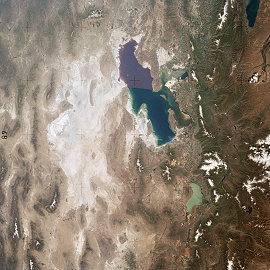
For nearly a month they made further repairs to the workshop,
conducted medical experiments, gathered solar and Earth science data, and
performed a total of 392 hours of experiments. The mission tracked two minutes
of a large solar flare with the
Apollo Telescope Mount; they took and returned some
29,000 frames of film of the sun. The
Skylab 2 astronauts spent 28 days in space, which
doubled the previous U.S. record.
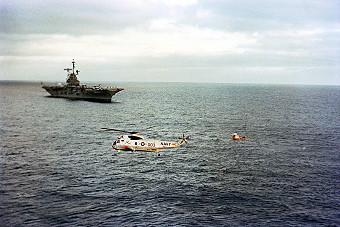
The recovery ship was the
USS
Ticonderoga.