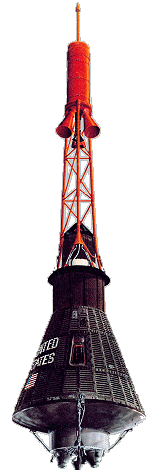
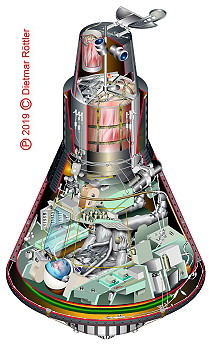
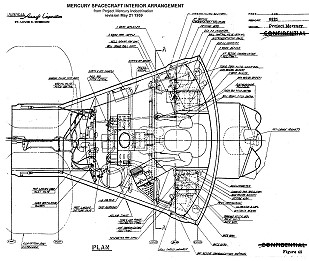
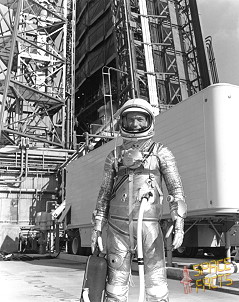
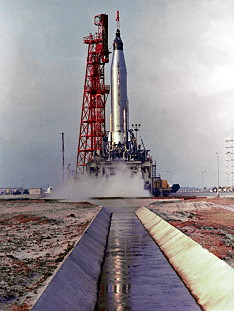
Launch from Cape Canaveral and landing 218 km
southeast of Puerto Rico in the Atlantic Ocean.
This flight was a
"repeat" of the
Mercury 6 mission.
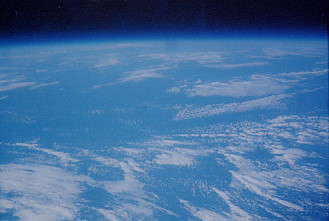
Several scientific experiments were carried on in orbit. For example, the
behavior of fluids in microgravity conditions was observed, and terrestrial
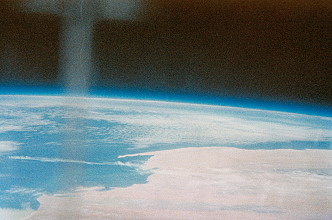
features and meteorological phenomena were photographed during the flight. An
experiment designed to provide atmospheric drag and color visibility data in
space through deployment of an inflatable sphere was partially successful.
Cabin and pressure suit temperatures were high but not intolerable.
The landing occurred 400 km from the target point due to navigation
problems caused by a failure in the spacecraft pitch horizon scanner, a
component of the automatic control system. This anomaly was adequately
compensated for by the pilot in subsequent in-flight operations so that the
success of the mission was not compromised. These problems caused a delay in
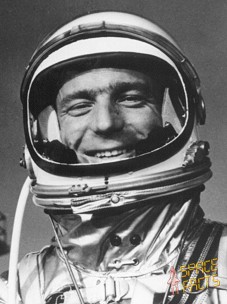
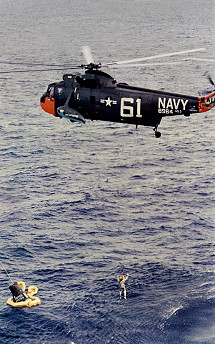
the operations timeline, and more fuel than expected was needed. Scott
Carpenter was picked up by helicopters dispatched from the
USS
Intrepid, while the capsule was retrieved by the
USS John R.
Pierce about 6 hours later.